Matchwinner with a flaw: Serhou Guirassy turns Borussia Dortmund's game against Heidenheim around, but there's still room for improvement.
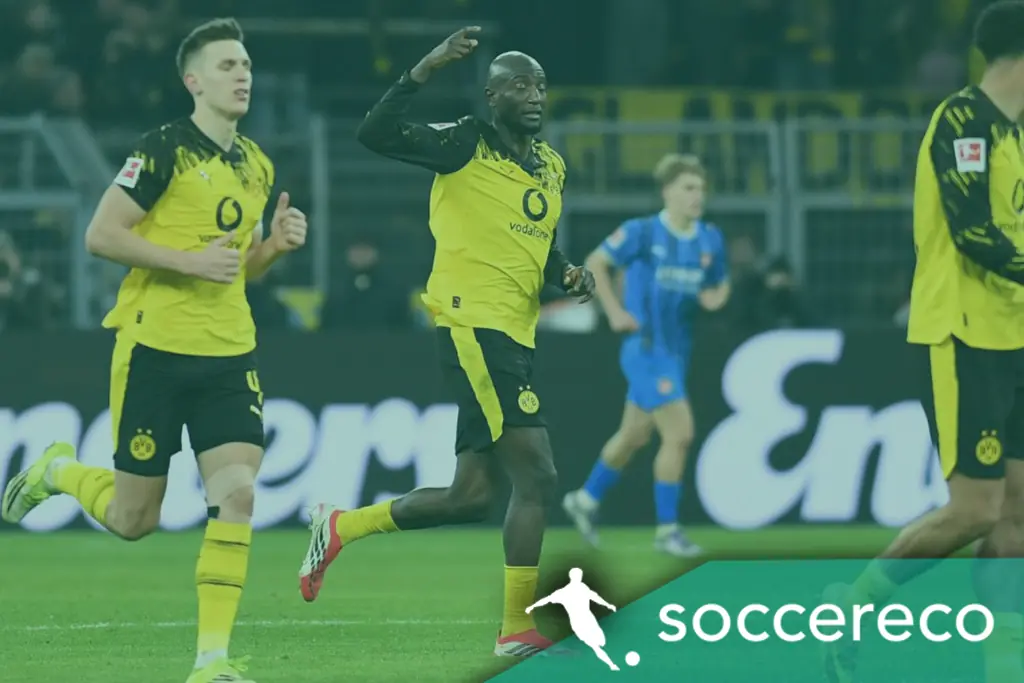
As stoppage time ticked toward its end, Serhou Guirassy crouched in front of the Südtribüne, close to the goal that had just delivered him both relief and another surge of pressure.
He had already been taken off, visibly spent, and needed a little help as he made his way toward the touchline and the bench while 1. FC Heidenheim 1846 threw forward their final desperate attacks. It was a small, telling image: the match still unfinished, the crowd still braced for one last twist, and the striker at the centre of it all looking like someone who had carried far more than just ninety minutes on his shoulders.
Because these were not simply emotional minutes. They felt like a compressed version of a complicated season, the kind where every action is either a warning sign or a turning point. For long stretches before the break, Guirassy looked like a forward fighting himself as much as the opposition. His intention was obvious. He wanted involvement, he wanted contact with the ball, he wanted to force something to happen. But that urgency often produced the opposite effect. He drifted into the same corridors as teammates, checked toward passes that were already meant for someone else, and in a few moments seemed to block the very lanes Borussia Dortmund needed to exploit. When an attacker is short on confidence, the instincts can become blunt instruments: take the shot, take the touch, take the next moment, even if the better option is to step away and let the play breathe.
That is what made the turning point so striking. Not because the moment itself was unusual, but because everything around it screamed consequence.
A stadium holds its breath
When the clock reached the sixty eighth minute, an entire stadium seemed to inhale at once. Dortmund had been handed a penalty, the perfect opportunity to draw level against the side sitting at the bottom of the table. Under normal circumstances, the decision would have felt routine. But there was no routine in this situation. Emre Can, a regular taker and a player who usually projects authority in these moments, was absent through illness. His stand in Ramy Bensebaini was on the bench. The question rose immediately and loudly in the minds of everyone watching: who is brave enough, and trusted enough, to take responsibility now?
Nico Schlotterbeck picked up the ball first, a defender stepping into a role that often demands leadership more than technique. That gesture alone carried meaning. It suggested decisiveness, a willingness to shield the team from doubt. But then, at the last moment, he handed it to Guirassy. It was not a casual exchange. It was a deliberate transfer of ownership, almost a public statement: this is your chance to reset the story.
The complication was obvious. Guirassy had recently missed two penalties in a row. For a striker, that kind of sequence is more than a statistical blip. Penalties are supposed to be moments of control, almost a private conversation between taker and goalkeeper. When you miss repeatedly, the noise becomes impossible to ignore. The run up feels longer, the target feels smaller, the mind starts to rehearse failure even as the body prepares to strike.
Guirassy did not show hesitation. His approach was firm, his contact clean. Diant Ramaj got a hand to the ball, which often is enough to keep it out, but not this time. It still found the net. Equaliser. Release. A roar that sounded like it came from somewhere deeper than celebration, more like a collective exhale after a long spell of tension.
And then something changed, quickly.
What happened next was the best illustration of how fragile and valuable a striker’s belief can be. In the first half, Guirassy had already been close, including a composed chip after a clever movement that hit the crossbar. That is the kind of chance that can either haunt you or reassure you, depending on what comes next. After the penalty went in, the earlier miss looked less like a warning and more like a preview.
Only eighty four seconds after his first goal, Guirassy struck again. The finish was not perfect, and it did not need to be. It took a slight deflection, squeezed past Ramaj’s leg and nestled in the near corner. Suddenly it was 3 2, and the whole match flipped. Dortmund were no longer chasing. They were leading. Guirassy was no longer the attacker getting in the way. He was the matchwinner, for a moment reborn.
That second goal mattered beyond the scoreboard. It was the kind of finish that tells you a player is acting on instinct rather than overthinking. It was direct, decisive, and ruthless enough to turn pressure into advantage. For Dortmund, it was also a reminder of why they rely on him. Even on a day when his overall play had been messy, the decisive contribution arrived when it was needed most.
He wanted to try something again
About a quarter of an hour later, Guirassy was fouled in the box again. Once more Schlotterbeck took control of the ball, shielding it, managing the moment, setting the scene. Once more he handed it to Guirassy. The stadium went back into that tense silence that penalties create, the silence where you can almost hear the thought process.
This time Guirassy tried to be clever. He chipped the penalty and sent it over the bar. In one swing, the chance to kill the game disappeared, the hat trick vanished, and a final, complete personal release slipped away. It was the exact type of decision that splits opinion: the daring choice that looks like confidence when it works and like unnecessary risk when it fails. In this case it was the latter, and it invited criticism, including from Niko Kovac, who made it clear he was not impressed by the attempt to do something fancy in such a decisive moment.
For Guirassy, the miss did not erase what he had done. Dortmund still had the lead. They still had two goals from their striker. But emotionally, it reopened the door to doubt. Instead of walking off with a clean narrative of rescue and redemption, he was left with a match that mirrored his season: brilliant impact wrapped in imperfection, a decisive contribution alongside a moment that leaves you shaking your head.
That is why the image from stoppage time lingered. The crouched figure near the goal was not just fatigue. It looked like a player processing everything at once: the relief of scoring, the frustration of missing, the awareness that the team still needed to survive the final attacks, and the knowledge that his own story will keep being examined in close up.
For Dortmund, the bigger takeaway was practical. The comeback showed resilience and the ability to change a match quickly, even when the performance is uneven. For Heidenheim, it was another painful example of how fine margins can be, how a match can be shaped by moments rather than long stretches of decent work.
For Guirassy, it was both a step forward and a reminder of the work still to do. The goals prove the instinct is still there, the composure can still return, and the impact is undeniable. The missed second penalty shows the line between confidence and overconfidence is thin, and that the simplest option is often the strongest one when everything is on the line.
In the end, the match did not offer a neat conclusion. It offered something more realistic: proof that a striker can drag a team over the line even while still fighting parts of his own game. Two goals, a missed chance to finish the story perfectly, and ninety three minutes that felt like a season squeezed into one night.