The Spanish media were harsh on Real Madrid after the painful cup elimination against Albacete. On Wednesday, the team led by debuting head coach Álvaro Arbeloa lost to the side ranked seventeenth in the Segunda División. “Now there’s no coach left to blame.”
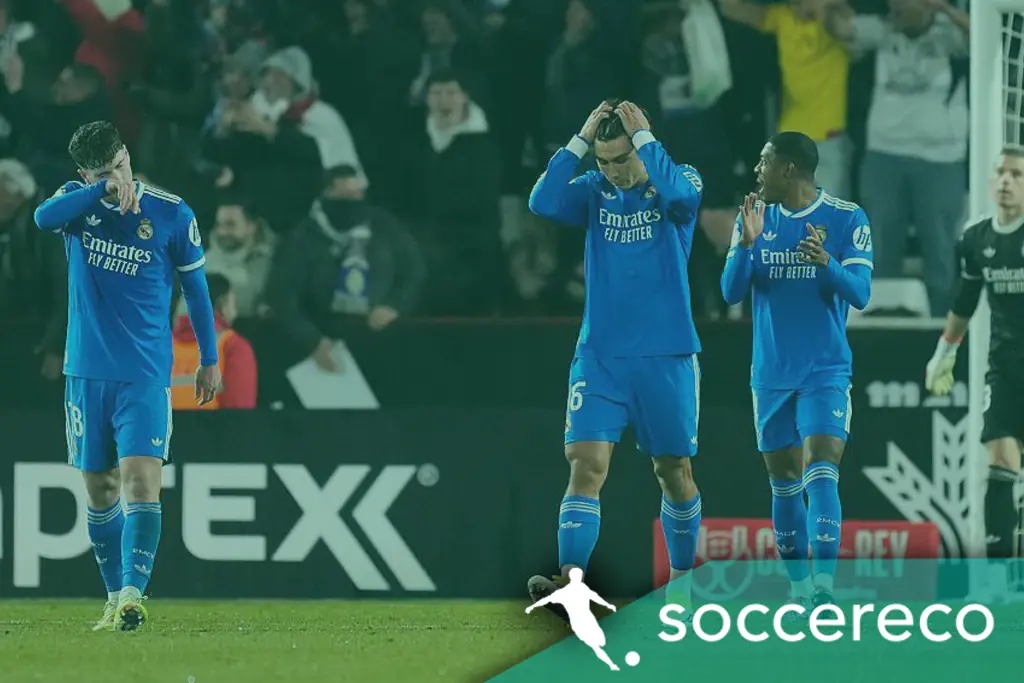
Real Madrid’s latest collapse has sparked a wave of brutal criticism in Spain, after Albacete eliminated the holders from the Copa del Rey with a 3–2 victory on Wednesday night.
The result was damaging enough on its own, but the context has turned it into a symbol of a broader malaise: a club already under pressure, in the middle of upheaval, now suffering what local outlets describe as a humiliation that confirms the scale of the current crisis.
Marca did not soften its verdict, describing “a Real Madrid that is downright embarrassing” and highlighting a familiar pattern that, in their view, has defined the team for months. Albacete, they argued, approached the occasion with sharper focus and greater collective commitment, while Real once again played with an alarming lack of urgency. Crucially, Marca insisted the defeat should not be pinned on Arbeloa, who was taking charge for the first time, but rather on a broader, recurring failure inside the squad. The paper painted a picture of a team that repeatedly slips into passive performances, where intensity is optional and motivation fluctuates, regardless of who is in the dugout.
That point is central to why the post-match reaction has been so severe. Marca explicitly framed the match as another chapter in a sequence of disappointing “projects,” suggesting that under both Xabi Alonso and Carlo Ancelotti the club failed to build something coherent or sustainable. In that reading, Albacete was not an outlier or a freak cup upset, but a predictable consequence of months of instability, underperformance, and a dressing room that no longer consistently responds to pressure moments.
The paper’s imagery underlined the humiliation. Marca referenced the mist visible in the opening stages and argued that the worst possible development for Real was the fog clearing after the first twenty minutes, because the “shameful performance” then became impossible to hide. The symbolism was obvious: once visibility improved, so did the clarity of the problems Real have been carrying. They described the situation as a crisis “of unprecedented proportions,” pointing to the chaos of recent days, including pressure from results, a coach being dismissed, and a new coach beginning his tenure with limited options and a squad that looked mentally fragile.
Diario AS took a similarly unforgiving line, calling Arbeloa’s first match “a disastrous start.” Their argument focused on how the team selection and the dynamics of rotation backfired. AS portrayed Real as a side filled with substitutes and youth players that simply collapsed under pressure, and they emphasised the sporting cost: for the second time in a week, Real squandered a realistic route to a trophy. That framing is important, because cup competitions are often viewed as the most direct path to silverware during turbulent seasons. By letting that opportunity slip, Real not only lost a competition, but also removed a potential lifeline that could have stabilised mood, reduced external pressure, and bought time for a new coach.
AS also set expectations for what happens next in bleak terms. Even if there is a response, they warned, it will likely be slow, because a disaster of this magnitude becomes part of club history and leaves scars. In their view, the match against Albacete exposed a deeper structural issue: the bench is not a safety net. Rotation, which is usually an instrument to protect the squad and manage the calendar, became a trap. AS argued Arbeloa “went too far” with changes and may have thrown away “the most realistic shot at silverware,” turning a strategic decision into a defining moment of his debut.
From Catalonia, Mundo Deportivo delivered the most pointed interpretation. They called Arbeloa’s debut “an outright disaster” and used it to make a broader claim: Xabi Alonso was not the problem. In other words, changing the coach does not automatically change the fundamentals. Mundo Deportivo went further, suggesting Arbeloa’s arrival is not going to fix anything in the short term and may even complicate matters. The Albacete match, they wrote, was evidence that Real are drifting, “sinking deeper into the abyss,” and that the club currently lacks a clear figure in command.
Their most damning line captured why the narrative has become so poisonous: “There is no coach left to blame.” That is a direct implication that the responsibility now shifts more decisively to the squad, the club’s leadership, and the overall sporting structure, because the usual release valve, blaming the manager, has already been used. Once that option is exhausted, the scrutiny intensifies elsewhere: recruitment, squad balance, mental strength, internal hierarchy, and whether players are responding to the badge and the moment.
The immediate consequence is that Real move into a difficult stretch of fixtures with pressure sharply increased and very little margin for another misstep. Every match now becomes a referendum on whether the team is capable of a reaction or whether the crisis deepens further.