Jürgen Klopp has spoken for the first time as Germany head coach. During his presentation, the 59-year-old German emphasised the responsibility that comes with his new role and immediately set a clear boundary.
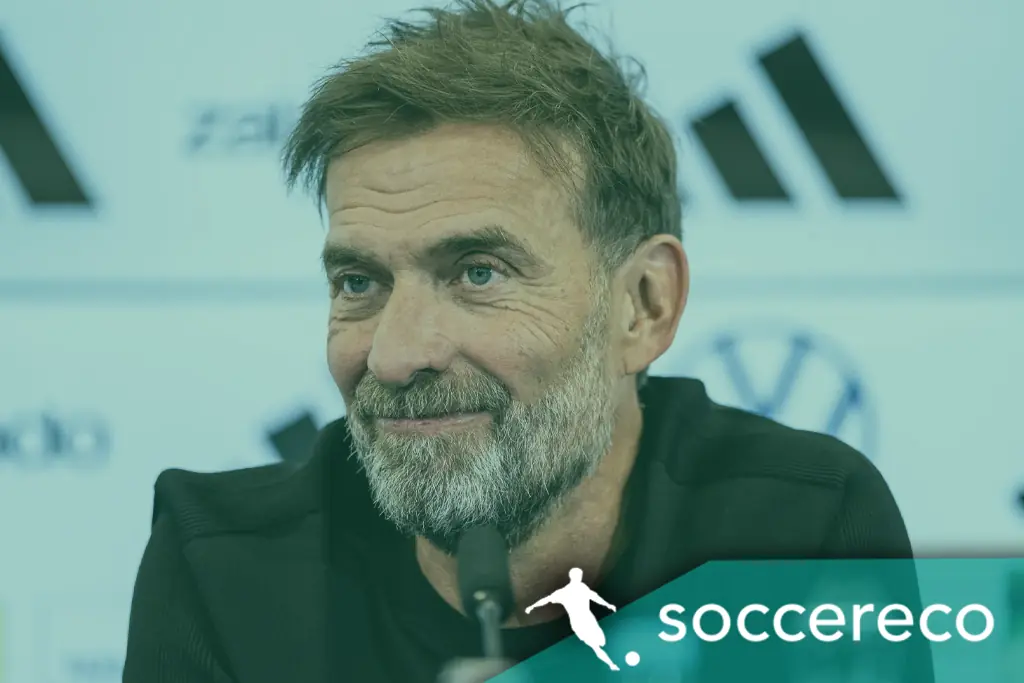
Jürgen Klopp takes charge of Germany and sets clear expectations from the start
Jürgen Klopp has officially been presented as the new head coach of the German national team, succeeding Julian Nagelsmann and beginning one of the most significant chapters of his career.
The 59-year-old was unveiled on Friday afternoon after an agreement was reached between the German Football Association and Red Bull, where Klopp had been working as Head of Global Football.
His appointment had been expected for some time, with speculation surrounding his future increasing as negotiations progressed. Once the conditions of his departure from Red Bull had been settled, the path was cleared for Klopp to accept responsibility for the German national team.
The agreement also includes several unusual elements. The German Football Association confirmed that €1 million will be donated to Wings for Life, the foundation associated with Red Bull, while Germany will play three international matches in Leipzig.
Those arrangements formed part of the discussions that allowed Klopp to leave his executive position and return to frontline coaching, this time in international football.
Klopp appeared emotional but determined during his first press conference. The former Borussia Dortmund and Liverpool manager admitted that the importance of the position had become even clearer once the appointment was confirmed.
“Over the past few days, it felt as though a film was playing in my head. All kinds of thoughts were going through my mind,” Klopp said.
“I already had some idea of how important this position is. But once you are personally involved, you feel the scale of it and the responsibility much more strongly.”
The role represents a major change for a coach who has spent most of his career working daily with club squads. International football offers far less preparation time, and Klopp will now have to adapt his methods to shorter training camps and a more limited calendar.
However, the German coach made it clear that he is fully aware of the challenge. His comments during the presentation suggested that he sees the position as far more than another job.
For Klopp, taking charge of Germany means accepting responsibility for the wider direction of football in the country. He repeatedly spoke about the future of the national team, the importance of the shirt and the need to rebuild a strong connection between the players and the supporters.
“If someone does not care about the future of German football, I cannot help them,” Klopp said.
The statement reflected the standards he intends to establish from the beginning. Klopp wants players, staff members and everyone surrounding the national team to understand that representing Germany must be treated as a privilege rather than simply another obligation in a demanding season.
His arrival will naturally create enormous expectations. Klopp remains one of the most recognisable German coaches in the world after successful periods with Borussia Dortmund and Liverpool.
At Dortmund, he built an energetic and highly competitive team capable of challenging Bayern Munich’s dominance. He later transformed Liverpool into one of the strongest sides in Europe, creating a team defined by intensity, collective commitment and a powerful connection with its supporters.
Those qualities are likely to shape Germany under his leadership. Klopp is associated with aggressive pressing, rapid transitions and emotionally committed football, although he will need to adapt those principles to the realities of the international game.
Unlike at club level, he will not have months of daily training sessions to establish detailed tactical patterns. Most of his work will take place during short international windows, often with only a few days available before important matches.
Klopp acknowledged that difficulty when discussing his first fixture. Germany will face the Netherlands on 24 September in the group stage of the Nations League, giving the new coach an immediate and demanding test.
The timing means that Klopp will have very little opportunity to work with the squad before the match.
“I will only have had the squad together since Sunday, and the match is already on Thursday. That gives me four days,” he explained.
Four days will not be enough to completely transform Germany’s style of play, but Klopp has already made clear that he expects visible signs of improvement.
“You will probably ask me afterwards whether I am satisfied with the progress. I want to see progress,” he said.
“It is about the players showing that representing the national team is something very special.”
The match against the Netherlands will therefore be viewed as more than the beginning of another Nations League campaign. It will provide the first indication of how quickly Klopp can transmit his ideas and raise the level of intensity within the squad.
His immediate priority is likely to be changing the mentality surrounding the team. Germany have experienced an inconsistent period in recent years, and the national side have often struggled to reproduce the authority traditionally associated with the country’s football.
Klopp will be expected to restore confidence, competitiveness and a stronger sense of identity. His public communication has always been one of his greatest strengths, and that ability could prove especially important in a national team environment.
During his presentation, he spoke directly and emotionally, but he also established clear boundaries. Klopp made several promises while warning that he would not remain in the role simply for financial security or personal status.
“If one day you no longer want me, just say so. Then I will leave without any compensation,” he said.
“If several people say tomorrow that it is all worthless, I will leave.”
The comments were consistent with Klopp’s reputation for honesty, although they also demonstrated how seriously he views the relationship between a national coach, the football authorities, the media and the public.
He made it clear that he does not intend to continue in the position if he loses the support required to perform the role properly.
Klopp also issued a strong warning concerning the treatment of his family.
“If you behave badly and refuse to leave my family alone, I will leave as well,” he said.
The remark introduced a more personal dimension to the presentation. Klopp has spent much of his career under intense public scrutiny, particularly during his years in the Premier League, but he clearly wants his private life to remain separate from his professional responsibilities.
His direct message to the media demonstrated that he is prepared to accept criticism of his decisions and performances, but he will not tolerate unwanted attention being directed towards those close to him.
The German Football Association will now hope that Klopp’s arrival can provide stability and renewed energy. Appointing a coach with his profile immediately increases interest in the national team and strengthens the belief that Germany can once again become a leading force in international football.
Klopp will also have to manage a squad containing players at different stages of their careers. Some are established internationals, while others are still attempting to secure a regular place within the team.
One of his main challenges will be creating a clear hierarchy without closing the door to younger players. His work at Dortmund and Liverpool showed that he is comfortable developing talent, but he also demands a high level of commitment from every member of the squad.
Players will be expected to press, defend collectively and respond immediately when possession is lost. Klopp’s football depends heavily on cooperation, meaning individual quality will not be enough to guarantee selection.
He is also likely to place considerable importance on physical readiness. The limited time available during international breaks means players must arrive prepared to train at high intensity from the first day.
Communication with club coaches and medical departments will therefore become an important part of his work. Klopp will need reliable information about the condition of each player while balancing the objectives of the national team with the demands of the domestic season.
The move also represents Klopp’s return to coaching after his executive role with Red Bull. His position as Head of Global Football gave him a broader perspective on recruitment, development and the management of football organisations.
That experience could help him understand the national team role beyond the tactical preparation of senior matches. He may also contribute to discussions about youth development and the long-term future of German football.
His statement about caring for that future suggests he intends to become involved in the wider project rather than concentrating only on immediate results.
At the same time, results will remain decisive. Germany are expected to compete for major honours, and Klopp’s reputation will increase pressure rather than reduce it.
Supporters will expect the team to play with greater energy and personality from the beginning. The first few matches will be closely analysed for evidence of the intensity and emotional connection that characterised Klopp’s best club sides.
The Nations League meeting with the Netherlands offers an ideal test. The rivalry between the countries adds importance to the fixture, while the quality of the opposition will reveal how Germany respond under pressure.
Klopp may only have four days of preparation, but he has already refused to use the limited time as an excuse. His demand for progress suggests that he expects basic principles to be visible immediately.
Those principles are likely to include aggressive pressing, compact distances between the lines and a willingness to attack with speed when opportunities appear.
He will also want to see emotional commitment. Klopp has repeatedly built teams capable of creating a strong relationship with supporters, and he is expected to seek the same connection with the German public.
The coach understands that the atmosphere surrounding the national team has not always been positive in recent years. Restoring belief may therefore be as important as adjusting the tactical system.
His personality could prove valuable in that process. Klopp is capable of communicating complex football ideas in a direct and accessible way, while his enthusiasm often encourages players and supporters to believe in a common objective.
However, he also demonstrated during the presentation that his approach will not be based only on emotion. He spoke repeatedly about responsibility, standards and the need for everyone involved to take German football seriously.
The message to the squad was therefore clear even before the first training session. Wearing the national shirt must represent something exceptional, and players who fail to show that attitude are unlikely to remain central to his plans.
Klopp will soon begin making his first major decisions, including the selection of his squad for the September international window.
Every choice will attract attention. Established players will want to understand their role, while younger candidates will see the change of coach as an opportunity to earn a place.
The captaincy, leadership group and tactical structure will also be important subjects during the first camp. With so little preparation time, Klopp will need experienced players capable of helping him transmit his ideas throughout the squad.
His appointment has already changed the mood around the national team. The arrival of a coach with his record creates optimism, but Klopp has attempted to balance that excitement with realism.
He knows that his reputation alone will not solve Germany’s problems. The team must work, improve and demonstrate on the pitch that a new period has genuinely begun.
The donation to Wings for Life and the agreement to play three matches in Leipzig are unusual details surrounding the move, but the sporting focus will quickly turn towards the Netherlands fixture.
That first match will not define Klopp’s entire tenure, yet it will offer an early opportunity to establish the tone he wants.
Germany’s players will have four days to understand the basic demands of their new coach and show that they are prepared to respond to his expectations.
Klopp, meanwhile, begins the role with a clear message. He accepts the responsibility, understands the pressure and wants everyone around the national team to share the same commitment.
He has also made clear that he will not remain simply because of a contract. Support, honesty and respect will be essential conditions throughout his time in charge.
For German football, his appointment represents a major moment. For Klopp, it is the opportunity to apply the experience gained at Mainz, Borussia Dortmund, Liverpool and Red Bull to the most important coaching position in his home country.
The next phase begins on 24 September against the Netherlands, but the tone of the new era has already been established. Klopp wants progress, commitment and a renewed understanding of what it means to represent Germany.