Benfica edged out a nervy win over Gil Vicente on Monday evening and can now turn its attention to the league showdown against FC Porto. Despite the victory, Benfica coach José Mourinho had plenty to complain about regarding VAR, while he spared the referee.
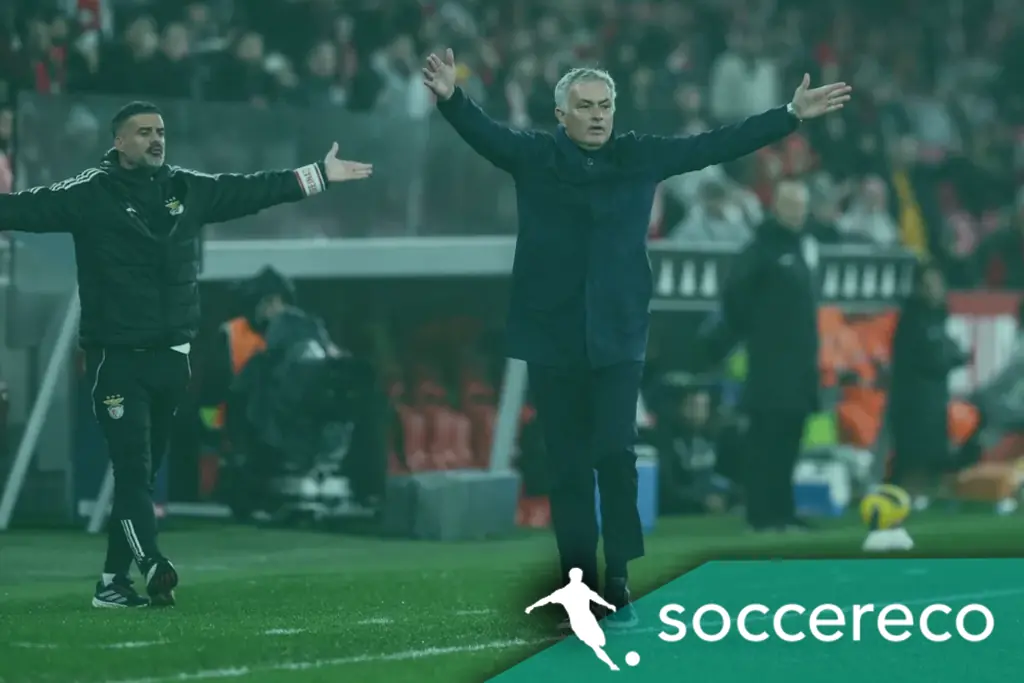
Benfica left Barcelos with a hard-earned 2–1 win over Gil Vicente on Monday night, but the scoreline only tells part of the story.
The visitors took three points and moved to 58 in the standings, yet the match had the feel of the kind of tight, awkward away fixture that can derail a title chase if concentration drops for even a moment. Benfica managed to come through it, but they did so amid tension, complaints, and a lingering sense from José Mourinho that the football itself was almost secondary to what he saw as another frustrating example of VAR failing to do the job it was introduced to do.
From the opening phases, the game demanded patience. Gil Vicente did not offer Benfica the comfort of easy rhythm or long spells of control. They competed for second balls, kept the crowd involved, and forced Benfica to repeatedly reset their attacks rather than build with flow. Benfica, for their part, played with the urgency of a team that knew it could not afford a slip with a major match against FC Porto looming. The pressure of that context was visible in the way Benfica tried to accelerate moments, looking to turn small openings into quick chances, but also in the way they occasionally looked impatient when play broke down.
The decisive talking point, though, arrived around a sequence that Mourinho believes should have produced a penalty. In his view, the infringement was obvious, the kind of incident that may be missed in real time due to the speed of the action, but should be corrected by the video officials who have the benefit of multiple angles and replays. Mourinho argued that not only was the decision wrong, it was baffling that it was not even fixed after review. His anger was sharpened by what followed, because, as he explained, the situation that he felt should have ended with a spot kick instead ended with a corner, and Benfica scored from that corner. In other words, the match moved on in a way that did not ultimately punish Benfica, but Mourinho insisted the principle still mattered, because the process was flawed and the same mistake could easily harm his team in another game.
“The move that led to our goal was clearly a penalty. I accept that the referee didn’t see it, because sometimes the game is moving at 200 kilometres per hour. But at that moment the VAR must have gone to get a cup of coffee, because he missed an obvious penalty,” Mourinho said.
It was notable that Mourinho directed most of his criticism at VAR rather than the referee on the pitch. He made a point of describing how difficult it can be for a referee to see everything as players collide, sprint, and change direction in an instant. That framing allowed him to sound almost understanding about the initial call, while still making his central argument: the whole reason VAR exists is to intervene when the error is clear and decisive. When that intervention does not happen, Mourinho believes the system stops being a safety net and becomes another source of confusion and irritation.
Even with the controversy, Benfica’s immediate concern was the scoreboard, and that is where the night ultimately went their way. The 2–1 win did not feel like a routine triumph, but it was the kind of result that matters in a championship season, where the table is shaped by collecting points on nights when a team does not sparkle. Benfica had to manage nervous moments, handle pressure as Gil Vicente pushed, and maintain enough composure to see out the game. The narrow margin only increased the sense of tension, because one late mistake could have undone all the work, and away matches like this have a habit of turning chaotic in the final stretch.
That is why the timing of this win is so important. Benfica can now approach the upcoming league clash with FC Porto with confidence that they did what was required in a potentially dangerous fixture. At the same time, the performance and the post-match reaction also underline how fine the margins are. Mourinho knows that against the league leaders, Benfica will not be able to rely on simply surviving difficult spells, because Porto will punish small lapses more ruthlessly. The coach’s message after the final whistle was therefore split between satisfaction with the points and a warning about what comes next.
“It’s our duty to give everything, as we always do. Of course a draw here wouldn’t be good for us,” Mourinho added at his post-match press conference. “In a home match of this importance, our aim is of course to win, but we know we have a very tough game ahead of us.”
His comments about a draw were telling. They show a team thinking in terms of the title race and the hierarchy at the top, not simply protecting position. Mourinho framed the Porto match as one where Benfica must be ambitious, because anything short of maximum effort risks leaving them chasing rather than controlling their fate. He also acknowledged the scale of the challenge, describing the next game as extremely difficult, which serves as both a realistic assessment and a way to keep expectations grounded.
There is also an underlying emotional edge now attached to that Porto clash. Benfica are going into it not only with three points earned, but also with their coach publicly questioning the reliability of officiating support. Mourinho’s “coffee” remark was obviously delivered with sarcasm, but it carried a serious implication: that Benfica cannot assume the technology will correct big mistakes when it matters. Whether that statement is intended as pressure on officials, a defense of his team in advance, or simply a release of frustration, it adds heat to an already high-stakes match.
In the end, Monday’s 2–1 win over Gil Vicente gives Benfica what they needed most: momentum and a league position that keeps them firmly in the fight. But it also leaves them with unresolved frustration, because Mourinho is convinced an “obvious” penalty was ignored and that VAR failed in a moment that, in his view, should be straightforward. Benfica won anyway, yet Mourinho’s point was clear: the fact that the mistake did not change the result this time does not make the mistake acceptable. With the showdown against FC Porto approaching, Benfica move forward with points on the board, pressure rising, and a coach determined to ensure that the next decisive moments are not lost to controversy.