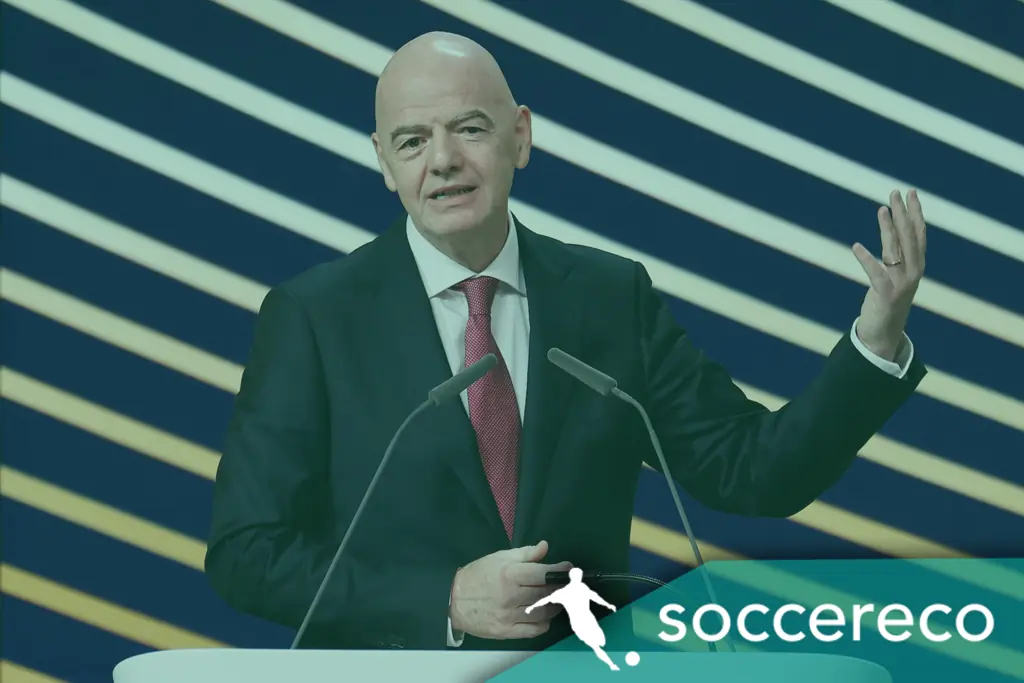
Gianni Infantino has the support of the South American football confederation if he wants to stand for a new term as FIFA president. That was indicated on Thursday evening by CONMEBOL president Alejandro Domínguez in a statement.
South American support arrives at a significant moment
Gianni Infantino has received an important political boost ahead of the next FIFA presidential cycle after CONMEBOL publicly signalled its backing for a possible new candidacy. The message came from Alejandro Domínguez, the president of the South American confederation, who used an official gathering connected to coaching development to underline the region’s united position. It was a short statement on the surface, but in football politics these gestures are rarely casual. When a confederation speaks with one voice, especially one with the history and weight of South America, the message tends to travel far beyond the room where it was first delivered.
Domínguez made it clear that the support from CONMEBOL was unanimous, a detail that matters. South American football has long seen itself as one of the spiritual homes of the sport, and its leaders are well aware of the symbolic and strategic value of their endorsement. By stepping forward now, the confederation has effectively placed itself at the front of the conversation over who should lead FIFA into its next phase. Even though Infantino has not formally announced that he wants to run again, the public assumption remains that he is prepared to continue if the political conditions stay favourable.
Why this endorsement matters
In the world of international football governance, timing is never accidental. Support declarations are not only expressions of confidence, they are also signals to other federations and confederations. CONMEBOL has now made it known that, from its point of view, continuity at the top of FIFA would be welcome. That does not automatically settle the question of the next election, but it does help shape the early landscape around it. Once one powerful bloc moves, others start to calculate their own position more carefully.
The South American confederation framed its backing around Infantino’s commitment to the development of football in the region. That language reflects more than diplomacy. Over the past years, FIFA has invested heavily in presenting itself as a governing body that spreads resources, visibility and institutional support across all corners of the game. For federations outside the traditional European power centres, that message has often carried considerable appeal. If CONMEBOL believes its interests have been heard and supported, then its endorsement becomes both a reward for past cooperation and a calculated investment in future influence.
Infantino and the long road since 2016
Infantino first rose to the FIFA presidency in 2016, at a moment when the organisation was still trying to recover from one of the darkest chapters in its history. The collapse of confidence that followed the corruption scandal around the governing body created a vacuum at the top, and he emerged as the man who promised reform, stability and a fresh direction. His background at UEFA gave him credibility within football administration, while his public style allowed him to project the image of a leader ready to modernise the institution.
Since then, his grip on power has only become stronger. He was re elected without opposition in 2019 and again in 2023, a sign not only of his political strength but also of the lack of any serious coalition determined to challenge him. That matters because FIFA elections are often less about dramatic public campaigns and more about network building, continental alliances and long term relationship management. Infantino has proved highly effective in that environment.
There is also an important technical detail around his time in office. A FIFA president can serve a maximum of 3 full terms, but Infantino’s first period did not count as a complete one because he took office part way through the cycle. That means there is still a pathway for him to remain in the role beyond the expiry of his current term next year. In practical terms, the institutional rules leave the door open. In political terms, endorsements such as the one from CONMEBOL suggest that many within football would be prepared to walk through that door with him.
The World Cup factor behind the scenes
There is also a broader strategic context that helps explain why South America may be especially keen to keep close ties with the current FIFA leadership. One of the major talking points around the 2030 World Cup has been the proposal to expand the tournament on a one off basis to 64 teams. The idea was reportedly pushed last year by Ignacio Alonso, the president of the Uruguayan federation, and it immediately stood out because it would turn an already historic competition into something even larger and more symbolic.
The 2030 edition already carries enormous emotional weight. It will mark 100 years since the first World Cup was staged in Uruguay in 1930, and FIFA has chosen to reflect that anniversary by ensuring the tournament opens in South America. Uruguay, Argentina and Paraguay are each set to host 1 match before the competition shifts fully to Morocco, Portugal and Spain. It is an extraordinary format, one designed to honour football history while also serving the commercial and political realities of the modern game.
Within that setting, any discussion about further expanding the tournament becomes more than a sporting debate. It becomes a question of representation, prestige and legacy. More teams would mean more nations involved, more political goodwill to distribute, and even more global attention on an already unique World Cup. It is easy to understand why such an idea would appeal to South American administrators who want the centenary edition to feel exceptional in every possible sense. If Infantino is seen as a leader open to that conversation, then the alignment between FIFA and CONMEBOL becomes even easier to understand.
A familiar pattern in football politics
This is how major football decisions are often shaped long before any formal vote takes place. Publicly, the language is respectful and forward looking. Behind it, however, lies a more complex balance of interests. Confederations back leaders who they believe will protect their influence, support their projects and recognise their historical importance. Presidents, in turn, build durable support by showing that every region has something to gain from staying close to the centre of power.
That is why this endorsement matters beyond the headline. It is not just about whether Infantino may choose to run again. It is about the early construction of a coalition, the reinforcement of a leadership narrative, and the continued intertwining of World Cup politics with FIFA governance. South America has now made its position clear, and that alone ensures the next chapter of football politics will begin with Infantino in a stronger place than before.
What happens next
For now, the key uncertainty is simply whether Infantino will formally declare his intention to seek another mandate. Until that happens, every endorsement remains technically conditional. Even so, the direction of travel appears obvious. There is no visible challenger of comparable stature, and there is no sign yet of a broad movement determined to bring change at the top. With CONMEBOL now openly supportive, the atmosphere around the next FIFA election looks increasingly familiar: continuity, careful alliance building and another reminder that in football, power often moves quietly before it moves publicly.