The Brazilian returns to a special setting in the midst of a season marked by inconsistency and the noise generated by some of his decisions.
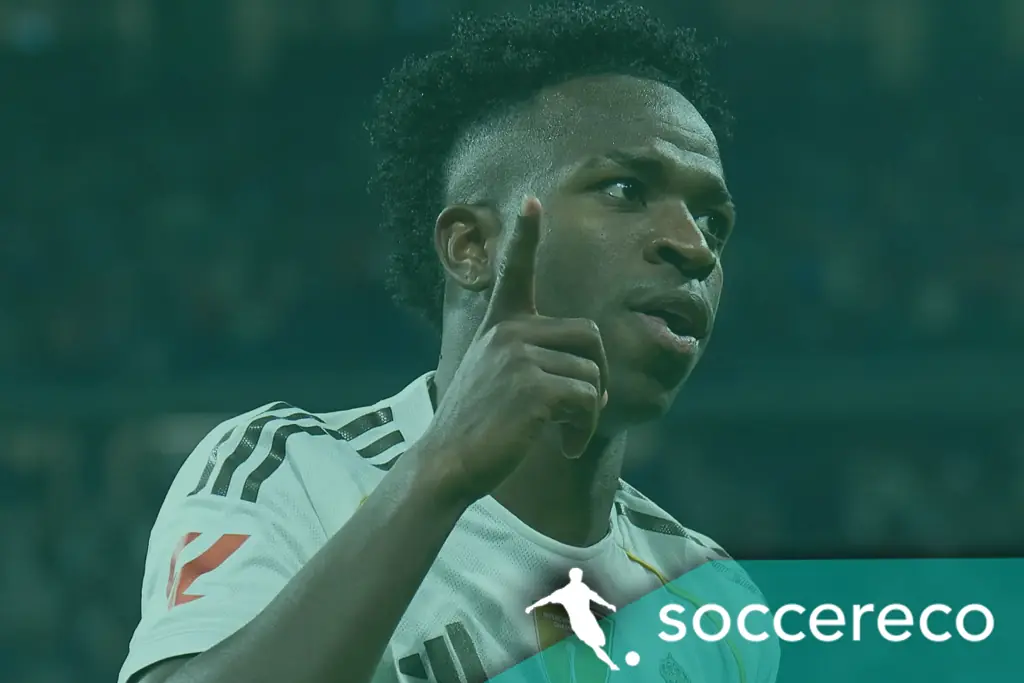
Vinícius returns to a place that brings back good memories at a time when he needs more than just a good match.
He needs to rediscover his feelings on the pitch, to reconnect with that instinctive, fearless version of himself that used to play without overthinking. The Brazilian star is not going through his best spell and his football, far from disappearing, has become more irregular and less natural than usual. When his game flows, he is one of the most decisive players in the world, capable of changing a match with one run, one dribble, or one burst of acceleration. But when doubts creep in, his choices become heavier, his actions more forced, and the sense of spontaneity that defines him starts to fade.
That quote is not just a line from a press conference. It is a diagnosis of the situation, and also a reminder of how Vinícius operates. He is a player who thrives on energy: confidence, connection with teammates, a positive mental state, and the feeling that his football is speaking louder than anything around him. When he is comfortable, he plays with joy and aggression, constantly looking for the duel, constantly asking questions of defenders. When he is not, he can look like a player trapped between the urge to be decisive and the fear of making the wrong decision, which is exactly what makes his current moment so delicate.
The season has been very complicated for him. Struggling in front of goal with 16 matches without scoring, Vinícius has found himself stuck in a stretch where the ball does not go in even when he manages to get into good positions. For an attacker, and especially for an attacker who often works in bursts of inspiration, that kind of run can become mentally exhausting. It changes how you interpret moments: you start shooting a fraction earlier, taking an extra touch you would not normally take, forcing dribbles into traffic because you want to spark something. That is where the rushed decisions appear, and where the sense of natural rhythm can break.
The noise has only grown louder because it has not been limited to football. There has been talk surrounding his contract renewal, and when that conversation becomes public and persistent, it adds pressure in a subtle but constant way. Every performance gets filtered through an extra layer of interpretation. A quiet match becomes a story. A reaction to a substitution becomes a headline. A brief argument on the pitch becomes a sign of tension. Even when none of that tells the full truth, it shapes the atmosphere around a player, and for someone as emotional as Vinícius, atmosphere matters.
Then there is the question of attitude. The reports and observations about rebellious moments and confrontational gestures are not necessarily new in the sense that Vinícius has always played close to the edge, emotionally invested in every duel, every refereeing decision, every provocation. The difference is that, in his best periods, his football has provided the perfect shield. When he is scoring, assisting, and destroying full-backs, everything else is framed as competitive fire. When he is not producing, those same reactions can be seen as distraction, frustration, or loss of focus. The football has not disappeared, but the margin for interpretation has changed.
Vinícius remains a difference-maker, but he no longer plays with the same freedom because his smile is not the same anymore. That detail is important. Real Madrid supporters have always responded to the idea of stars enjoying themselves while winning. When Vinícius looks liberated, he lifts the stadium. When he looks tense, the stadium becomes more demanding, more impatient, more ready to question small things. It is not a complete break, but it is a sign that something has cooled. The crowd, accustomed to his best version, has started to show impatience with certain gestures they have not liked. In a club like Real Madrid, the emotional contract between player and fans is simple: perform at the highest level, and you will be protected. When the performance drops, everything becomes more conditional.
That is why the comments from people around the team resonate. The line from Carvajal, saying that if he were a coach and he took a player off and the player did not get angry, he would be the one getting angry, is not only a defense of Vinícius. It is also a reframing. Anger can be interpreted as commitment, as a sign that the player cares, as a refusal to accept mediocrity. In that view, the problem is not emotion itself, but how that emotion is channeled. And that brings the focus back to Xabi Alonso’s point about emotional intelligence, about approaching each player in the right way at the right moment.
The context, tactically and structurally, has also not helped. When a player like Vinícius is at his best, he benefits from a clear platform: teammates who understand when to find him early, runners who stretch the line to create space, midfielders who feed him in advantageous situations, and a structure that allows him to receive with time and one-versus-one opportunities. If the team’s attacking rhythm is inconsistent, if the build-up becomes predictable, or if opponents can double up on him without being punished elsewhere, his game can become more complicated. He is still capable of producing moments, but the overall flow becomes harder to access.
That is why this return carries special meaning. It is not only about the opponent or the venue, but about what it represents. This is a stadium and a setting tied to a version of Vinícius that felt unstoppable. There, he was decisive, played without inhibitions, and delivered some of the best performances of his recent career. Everything came naturally to him. He took players on, danced across the pitch, and was decisive with a hat-trick that won Real Madrid the Spanish Super Cup against their eternal rivals. It was the kind of performance that shapes narratives, not because it was a lucky night, but because it looked like the purest expression of his talent.
That memory matters because footballers do not only rely on tactics and training. They rely on emotional anchors, on moments that remind them what they are capable of. Returning to that point does not guarantee a perfect night, but it offers a clear opportunity to reconnect with his football. Sometimes a player needs a match that feels familiar, a backdrop that triggers confidence, a place that tells him, without words, you have done it here before. That is the psychological advantage this return can provide: not certainty, but possibility.
For Vinícius, this game also represents a chance to simplify. When a player is struggling, the most dangerous thing is trying to solve everything at once. You start forcing plays, attempting spectacular actions every time you touch the ball, turning each possession into a test. The smartest path is often the opposite: rebuild through small victories. Win a couple of duels. Complete a few combinations. Make one clean burst in behind. Draw a foul in a dangerous area. Put in one early cross that creates a chance. These are the small details that restore belief. Regaining confidence means feeling comfortable again, and comfort comes from repetition of good decisions rather than one miracle moment.
That is why the idea of responding matters, but not in the way people usually mean it. This is not about silencing critics in a single night, or proving something to rivals, or delivering a statement performance because of what has been written. It is primarily about responding to himself. A player like Vinícius knows exactly when he is playing at his level and when he is not. He feels it in his choices, in his timing, in the way the ball sticks to his foot, in the way defenders react to him. When he is fully himself, defenders back off. When he is not, they step in. So the real objective is internal: restore the sensations that make him dangerous.
Sometimes it is not about changing anything, but about remembering how it was done when everything was working. Less conditioned by the noise and more focused on the game. Less reactive, more instinctive. Less concerned with proving something, more committed to expressing himself. That is the path back to the version of Vinícius that Real Madrid needs, and that he needs.
This return also comes at a point where Real Madrid’s environment is particularly unforgiving. The club’s season objectives do not pause for personal rebuilding. The demand is constant, the spotlight is permanent, and every week brings a new test with enormous consequences. In that setting, a player who is slightly off can quickly become a subject of debate. Vinícius does not have the luxury of disappearing while he finds himself. He has to do it in real time, on the biggest stages, with the weight of expectation on his shoulders.
That is why this match carries more meaning than a normal fixture. It offers an emotional reset button, even if only a partial one. A good performance there can shift the tone around him. It can reduce the pressure, at least temporarily, and allow him to play with more air in his lungs. It can also remind teammates and supporters of the version of Vinícius that changes titles, not headlines.
And that is the key point: his football has always spoken loudest when he is free. When he is happy, he plays with joy and ruthlessness. When he is smiling, the opponent feels it. This time, the memory waiting for him is not only about the hat-trick, not only about the trophy, but about the feeling of being himself again. A place where Vinícius was happy, where his football spoke for him, and where his smile became the same as it has always been.