Barcelona produced one of their best performances of the season on Wednesday night in the Spanish Super Cup semi-final against Athletic Bilbao. That is the conclusion drawn by the Spanish sports newspapers after the emphatic 5-0 win, which sets up a possible clash with Real Madrid in the final.
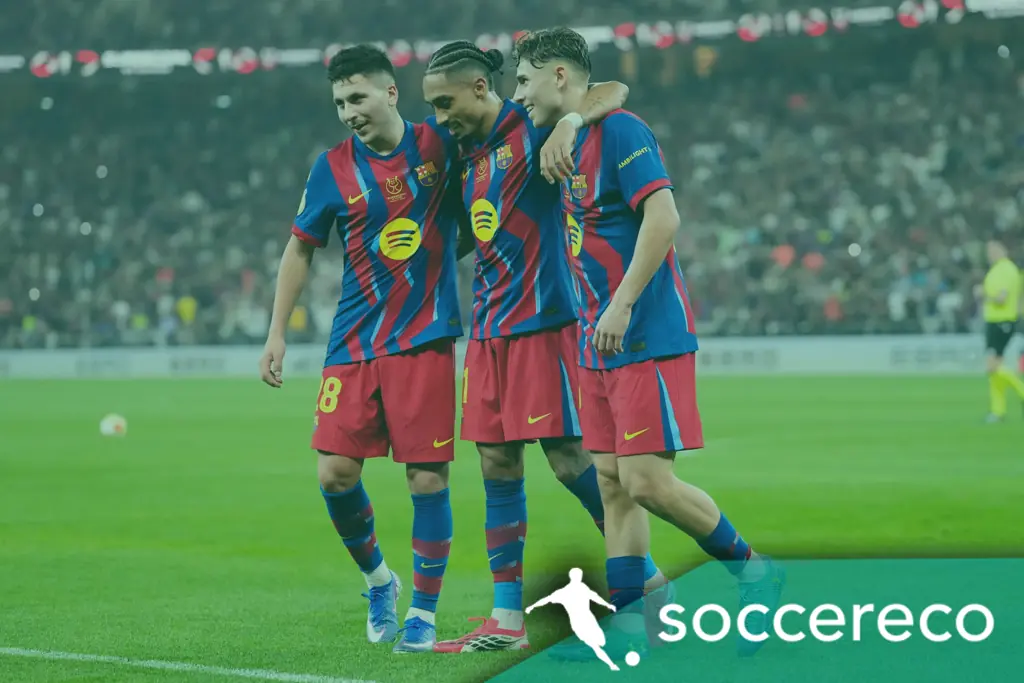
Barcelona’s emphatic 5-0 win over Athletic Bilbao has sent a clear message to the rest of Spain: Flick’s side are peaking at exactly the right moment, and the Spanish Super Cup final is now firmly on their radar.
The only remaining question is whether the showpiece match will deliver the most anticipated scenario of all, a Clásico against Real Madrid. That depends on Real getting past Atlético Madrid on Thursday night, a task that looks far more complicated than the one Barcelona made appear in the tournament’s first semi-final in Saudi Arabia.
The context matters. Real’s earlier league meeting with Atlético this season ended in a chaotic 5-2 scoreline, and it served as a reminder that derby games rarely follow a predictable script. Atlético’s intensity, defensive organisation, and ability to punish mistakes in transition is precisely the kind of test that exposes any team that is even slightly off rhythm. That is why Mundo Deportivo’s line about Barcelona’s semi-final lasting only ten minutes lands with such impact. It is not just a comment on the speed of Barcelona’s start, but on how quickly they removed uncertainty from the contest. From the opening phase, Barça imposed their tempo, suffocated Athletic’s build-up, and forced the match into a one-way pattern where Bilbao were reduced to survival mode rather than competing on equal terms.
By half-time the scoreboard read 4-0, and the game was effectively over. Spanish media framing naturally followed, focusing not only on Barcelona’s quality but on what it meant for Athletic and Ernesto Valverde. One of the more pointed observations was that, had Barça maintained the same relentless pace after the break, the result could have spiralled into something politically dangerous for Athletic’s coach. Sport suggested that Valverde’s position could have been seriously undermined if the second half had mirrored the first. The irony is notable: Valverde has experienced the pressure of Barcelona’s expectations from the inside and, in past chapters of his career, suffered consequences after a Saudi-based semi-final defeat involving Barça. This time, the reporting hinted, he is protected by Athletic’s culture, a club perceived as less reactive and less ruthless than many elite institutions when it comes to short-term results.
For Barcelona, the story is very different. There has been no comparable debate around Hansi Flick, at least not in the way top clubs sometimes turn on their coaches after a brief downturn. The mood around Camp Nou has largely treated this as a project with a clear direction, and Wednesday night felt like a milestone. Spanish outlets described a Barcelona that “swung” again, the kind of expressive, quick-passing, high-tempo football associated with the club’s best eras. Beyond the goals, the performance suggested something deeper: a collective identity that is now strong enough to withstand individual absences or disruptions.
That is where Sport’s analysis becomes significant. Rather than presenting Barcelona as dependent on a few stars, the paper argued that the system itself has become the headline act. The line “the team is the star” captures a shift from personality-driven narratives to structural ones. The example used is telling: if Lamine Yamal does not play, then Roony can be “sensational”. The implication is not that every player is equal in talent, but that the roles are so clearly defined and the patterns so rehearsed that replacements can step in without the mechanism losing power. In modern elite football, this is often the difference between a good side and a trophy-winning machine: the best teams reduce volatility by making their identity non-negotiable.
This makes Barcelona’s recent trajectory even more striking because the season has not been a straight climb. October and November were described as a difficult period, when performances dipped and confidence looked less stable. But the theme being pushed now is timing. According to the Spanish press, Barcelona have once again found their best level precisely when it matters. That is a familiar pattern in trophy seasons: league form can fluctuate, but knockout tournaments demand momentum, clarity, and belief. The coverage leans into that psychological dimension, suggesting that the “scent of trophies” is already circulating inside the dressing room, and that the squad’s appetite is growing rather than being satisfied by one big night.
That belief is amplified by how convincing the win was. Reaching the final is one thing; doing it with such control and intensity is another. The media interpretation is that Barcelona now enter the final as immediate favourites, regardless of the opponent. Even if the final becomes a Clásico, the argument goes, Barcelona’s performance level and cohesion give them a platform that is difficult to disrupt.
Players were careful, but the ambition is visible. Pau Cubarsí’s comments reflect a squad that embraces the spectacle while trying to stay professional in tone. He openly acknowledged what most fans and broadcasters want: a final against Real Madrid. Yet he also stressed the message Flick likely repeats internally, that Barcelona must go all out whoever stands on the other side. Cubarsí highlighted two themes that match the post-match narrative: the spectacular level of the attacking players and the importance of defensive solidity. In big finals, clean sheets often define outcomes more than moments of brilliance, and Barcelona’s renewed ability to shut games down is clearly being treated as a sign of maturity.
That defensive note is supported by the numbers: Barcelona have now kept a clean sheet for the fifth match in a row. In isolation, a clean-sheet run can be dismissed as a fixture quirk. In combination with a 5-0 semi-final, it becomes a statement about balance. Barcelona’s attack is attracting headlines, but their structure without the ball is giving them the foundation that often separates entertaining teams from champions.
Their broader winning streak adds to the sense of acceleration. Since a painful 3-0 defeat to Chelsea in the Champions League, Barça have reportedly won nine matches in a row. That kind of rebound is rarely accidental. It typically signals either a tactical correction, a shift in confidence, or a squad’s collective decision to respond. Raphinha’s post-match quote fits perfectly into that interpretation. He framed matches as something Barcelona can largely control through their own approach: whether a game becomes difficult or easy, he suggested, depends on the level and mindset Barcelona bring. He also struck a tone that combines satisfaction with ambition, insisting the team is still not at its absolute peak while acknowledging that beating Athletic 5-0 is never simple. That is the language of a team that feels it is building toward something rather than merely enjoying a good result.
Flick, for his part, kept the brakes on. This is standard management in January tournaments: you enjoy the performance but refuse to let it become a trap of complacency. His reference to the previous match against Espanyol, where Barcelona were not good, was an intentional reminder that football is not a linear story. One night you dominate, another you struggle. Flick’s praise was focused on the controllable elements: playing as a team and maintaining full control. That is a coach speaking the language of processes rather than outcomes. He also made an obvious point with real weight: the final will be different. The opponent will likely be stronger, the psychological pressure higher, the margins smaller, and moments of overconfidence more costly.
Another subplot is the fitness of Lamine Yamal. The teenage star’s absence from the starting line-up was attributed to stomach issues, and he remained on the bench. If he is fully fit for the final, Barcelona gain not only a high-ceiling attacking option but also a tactical advantage. Yamal’s presence stretches defences, creates one-v-one situations, and forces opponents to commit resources to his flank. In a final that may feature Real Madrid’s pace and transitional threat, having a wide attacker who can hold the ball under pressure and create danger in isolation can be decisive.
All of this sets up Thursday’s semi-final as a pivot point for the tournament’s narrative. If Real Madrid beat Atlético, the Super Cup final becomes a global event by default, a Clásico on foreign soil with a trophy at stake and both clubs under intense spotlight. If Atlético progress instead, the final becomes a different kind of challenge: a tactical battle against a team that thrives on structure, intensity, and exploiting space. Either way, Barcelona head into the final with momentum, defensive confidence, and a sense that the system is now carrying them as much as any individual.
The broader message from Spanish media is clear: Barcelona are not simply winning, they are developing an identity that travels, an approach that can overwhelm opponents early, and a mentality that appears sharpened by the setbacks of autumn. If the semi-final against Athletic was a demonstration, the final will be the test of whether this “machine” can deliver silverware when the pressure is at its highest.