FIFA explains why Jude Bellingham avoided a red card as the new mouth covering rule creates debate after Miguel Almiróns dismissal.
Bellingham escapes red card as FIFA explains controversial mouth-covering rule
England and Ghana played out a 0-0 draw in a match that produced few goalscoring moments, but plenty of discussion away from the scoreboard. The main talking point after the final whistle was not a missed chance, a tactical decision or the result itself, but a moment involving Jude Bellingham and the interpretation of one of the most debated rules introduced for this World Cup.
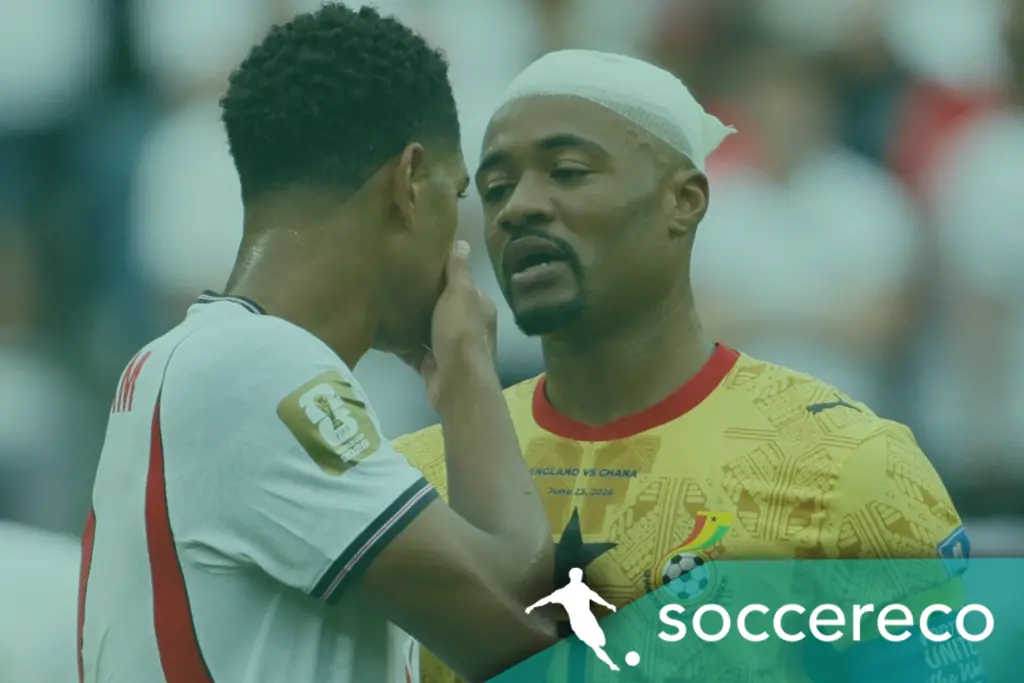
During the match, Bellingham was seen speaking while covering his mouth, something that immediately attracted attention because of the new disciplinary guidance being applied by FIFA during the tournament. In recent days, that rule had already caused controversy after Miguel Almirón became the first player to be sent off under the new measure. That incident created a clear precedent in the eyes of many supporters, which is why some fans quickly questioned why Bellingham was not punished in the same way.
The answer, according to FIFA, lies in the details of the rule and, above all, in the context of the conversation. The measure is not designed to punish every player who covers his mouth while talking. Instead, it is aimed at situations where players use that gesture during aggressive, hostile or confrontational exchanges, particularly when there is a suspicion that discriminatory, abusive or insulting language may have been used.
Almiróns case was very different, at least according to the interpretation made by the officials. The Paraguayan was involved in a heated moment during the match between Paraguay and Turkey when he spoke to an opponent while shielding his mouth. Turkish players immediately complained to the referee, suggesting that something serious had been said. After the incident was reviewed by VAR, the decision was taken to show Almirón a red card. He was then handed a one-match suspension, becoming the first player to be punished under the new interpretation.
That decision sent a strong message across the tournament. Players, coaches and supporters immediately understood that FIFA was prepared to take action in cases where mouth-covering was linked to a tense exchange. However, the incident also created confusion. Many assumed that the simple act of covering the mouth had effectively become a red-card offence. FIFA has now made it clear that this is not the case.
Referees chief Pierluigi Collina had already explained before the tournament that players are still allowed to speak while covering their mouths. In modern football, that gesture has become extremely common. Players often use it to protect tactical discussions, hide conversations from television cameras or prevent opponents from reading their lips. It happens during substitutions, set pieces, injury breaks and even casual conversations between teammates and rivals.
For FIFA, the important difference is whether the conversation is normal or confrontational. A friendly exchange, a tactical discussion or a private comment between players is not enough to justify disciplinary action. The situation only changes when the conversation appears aggressive, provocative or abusive. In those cases, covering the mouth can be interpreted as an attempt to hide something more serious from cameras, officials and lip-readers.
That is why Bellingham avoided a red card against Ghana. There was no indication that his conversation had crossed the line into hostility or abuse. There was also no immediate complaint from Ghana players that would have forced the referee or VAR to treat the incident in the same way as the Almirón case. Without clear evidence of a confrontational or discriminatory exchange, the officials had no reason to apply the most severe punishment.
The controversy shows how difficult this rule could be to manage in real time. Football is full of emotional moments, and players regularly talk to one another during tense phases of a match. Some exchanges are competitive without being abusive. Others may look aggressive from the outside but contain nothing that deserves punishment. Referees and VAR officials are therefore being asked to judge not only the gesture itself, but also the tone, timing and context of what is happening around it.
That creates a grey area. Supporters watching on television may see a player covering his mouth and immediately expect a red card, especially after what happened to Almirón. But the officials are not supposed to act simply because the gesture is visible. They must determine whether the gesture is connected to unacceptable behaviour. This makes consistency one of the biggest challenges for FIFA during the rest of the tournament.
FIFA president Gianni Infantino has defended the measure, arguing that the governing body has a responsibility to protect players and prevent abusive language from being hidden during matches. The intention is to stop players from using mouth-covering as a way to escape accountability when making discriminatory or insulting remarks. In an era where football authorities are under increasing pressure to act against racism, abuse and offensive language, FIFA wants to show that players cannot rely on cameras being unable to read their lips.
At the same time, the rule has raised concerns among players and coaches. Some fear that normal conversations could be misinterpreted, especially in high-pressure matches where body language can look more aggressive than it really is. Others believe the rule could encourage opponents to pressure referees whenever they see a player covering his mouth, even if nothing serious has been said. That possibility could make future matches even more difficult to control.
The England-Ghana incident has therefore become an important example of how FIFA wants the measure to be understood. Bellingham was not cleared because he is a high-profile player, but because the action itself was not enough to justify a red card. The key issue was the absence of a hostile or confrontational context. In FIFAs view, that separates his case from the Almirón incident.
Still, the debate is unlikely to disappear quickly. Every future case will be analysed closely, especially if another player is punished. Fans will expect clear explanations, and teams will want to know exactly where the line is drawn. The more this rule is used, the more pressure there will be on FIFA to prove that it can be applied fairly and consistently across different teams, players and match situations.
For now, the measure is being used only at the World Cup. It remains unclear whether domestic leagues and continental competitions will follow the same approach after the tournament. Much may depend on how many incidents occur, whether the rule helps prevent abusive behaviour and whether players adapt without creating further controversy.
What is already clear is that mouth-covering, once seen as a harmless habit in elite football, is now being watched more closely than ever. Players can still speak privately, but they must be careful about the circumstances in which they do it. In a calm exchange, there is no problem. In a heated confrontation, the same gesture can now carry serious consequences.
That distinction explains why Bellingham stayed on the pitch while Almirón did not. It also underlines the broader message FIFA is trying to send: the rule is not about banning private conversations, but about removing a possible shield for unacceptable behaviour. Whether that balance can be maintained throughout the tournament will be one of the most sensitive refereeing questions of the World Cup.