France face fierce criticism after a chaotic 6-4 World Cup defeat to England, with Deschamps blaming his selection and Rabiot condemning the team attitude.
French Media Tear Into Les Bleus After Chaotic 6-4 Defeat to England
France ended their World Cup campaign in extraordinary and deeply disappointing fashion after suffering a 6-4 defeat against England in the third-place play-off. A match that eventually produced ten goals and a dramatic French comeback attempt was largely defined by a disastrous first-half performance that left Didier Deschamps and his players facing severe criticism.
England raced into a 4-0 lead before the interval as France appeared disorganised, passive and emotionally disconnected from the contest. Les Bleus improved considerably after the break and came close to completing an astonishing recovery, but the damage caused during the opening period proved too great.
The defeat also marked the end of an era for French football. It was the final match of Deschamps as national team coach, bringing a long and successful spell in charge to an unexpectedly chaotic conclusion.
Deschamps had decided to make several changes to his starting line-up and give opportunities to players who had featured less prominently during the tournament. The decision was understandable in the context of a third-place match, particularly after the physical and emotional demands of the semi-final defeat against Spain.
However, the France coach may have regretted his selection almost immediately. His team began without intensity, defensive discipline or the urgency expected from a side still competing for a place on the World Cup podium.
England took full advantage. They attacked the spaces left by the French defence, moved the ball quickly and repeatedly exposed players who looked uncomfortable and uncertain in their roles.
By half-time, France were already four goals behind. The scoreline was damaging enough, but the manner of the performance created even greater concern. Several players appeared slow to react, reluctant to track runners and unable to respond collectively when England increased the tempo.
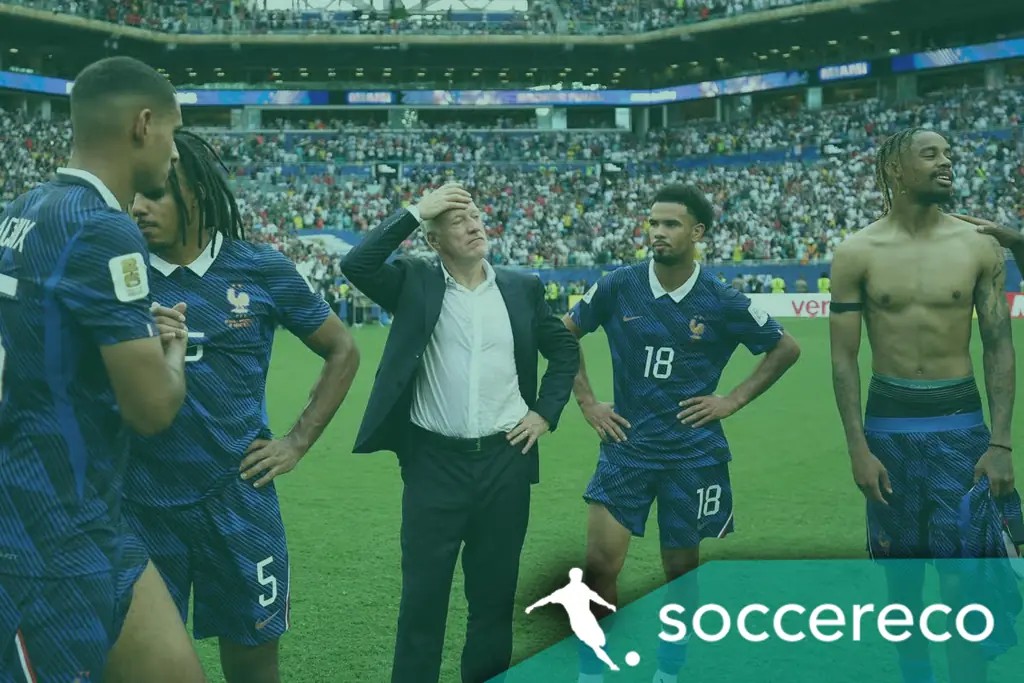
Deschamps refused to publicly blame individual players after the match. Despite the anger surrounding the performance, he attempted to protect his squad and accepted responsibility for the team he had selected.
He acknowledged that several internationals failed to reach their normal level and admitted that a different starting line-up may have produced a very different contest.
"I could have substituted eight players at half-time, but it was my mistake," Deschamps said.
The comment revealed the extent of his dissatisfaction. A coach rarely suggests that the majority of his team could have been replaced after only 45 minutes, particularly at a World Cup.
Deschamps eventually made several changes and France looked like a different side after the interval. Bradley Barcola, Lucas Digne, Ousmane Dembélé and Dayot Upamecano helped bring greater speed, aggression and structure to the team.
The substitutions changed the rhythm of the match. France pressed with far more determination, moved the ball forward more quickly and finally began to place England under sustained pressure.
Aurélien Tchouaméni praised the speech delivered by Deschamps during the break. The midfielder suggested that the coach succeeded in provoking the emotional reaction that had been missing during the opening half.
Whatever was said inside the dressing room clearly had an effect. France returned to the pitch with urgency and belief, reducing the deficit and creating the possibility of one of the most remarkable comebacks in World Cup history.
Barcola offered direct running and attacked defenders whenever he received possession. Dembélé brought unpredictability and technical quality in the final third, while Digne and Upamecano added greater balance and defensive security.
France eventually scored four times, but England continued to find opportunities of their own and added two more goals. The final score of 6-4 reflected the chaotic nature of the contest, with both teams abandoning much of their defensive caution during an extraordinary second half.
Although France showed pride after the interval, the comeback did not erase the embarrassment of the opening 45 minutes. The French media focused heavily on the lack of intensity, the poor body language and the absence of collective responsibility before the break.
L’Équipe described the first half as "humiliatingly poor" and struggled to understand how a team containing so many talented players could perform with such little resistance.
The newspaper went further, using the terms "self-sabotage" and "incredible indifference" when analysing the behaviour of several French internationals.
Those descriptions were not based only on technical errors. France misplaced passes, lost individual duels and defended poorly, but it was the attitude of certain players that created the greatest anger.
There appeared to be very little communication between the defenders. Midfielders failed to close spaces quickly enough, while attacking players did not consistently help when England advanced down the wings.
When possession was lost, France often reacted slowly. England players were allowed to run forward without immediate pressure, turning simple transitions into dangerous attacks.
The French defensive line also lacked coordination. Some players stepped forward while others dropped deeper, creating gaps that England repeatedly exploited.
The third English goal became one of the clearest examples of the problem. Malo Gusto was heavily criticised for the way he reacted after the move developed, appearing to jog back rather than sprint into a defensive position.
During the half-time analysis on NOS, former Feyenoord player Jerson Cabral openly mocked the defender effort.
"Look at the way Gusto is jogging back. He looked like my grandfather with his walking stick," Cabral said.
L’Équipe was equally severe in its assessment, stating simply that Gusto made too many mistakes.
The right-back received a rating of 2 from the French newspaper, placing him among the worst performers of the night.
Rayan Cherki, Désiré Doué, Ibrahima Konaté and Theo Hernández were also given ratings of 2. RMC Sport produced similarly brutal evaluations after the dreadful first-half display.
Cherki attracted particular criticism. The Manchester City playmaker had already endured a disappointing World Cup and failed to use the third-place match as an opportunity to improve the overall impression of his tournament.
His attitude came under scrutiny during the drinks break when he reportedly became involved in a disagreement with Deschamps. The coach attempted to give instructions, but Cherki appeared unwilling or unable to follow them.
He was substituted at half-time, ending a performance that French media described as anonymous and tactically undisciplined.
The incident was especially damaging because it took place during the final match of Deschamps tenure. The coach had given Cherki an opportunity to start, but the player failed to respond with the intensity required.
Désiré Doué also struggled to influence the game. The talented attacker is normally capable of creating moments of individual quality, but he found little space and contributed almost nothing to the defensive effort.
Konaté endured a difficult night in central defence. England repeatedly exposed the spaces around him, while his positioning and decision-making came under pressure from the speed of the opposing attack.
Theo Hernández, usually one of the most dynamic left-backs in international football, was also unable to produce his normal level. He offered little defensive protection and did not provide enough attacking influence to compensate.
France looked like a collection of individuals rather than a functioning team. That lack of cohesion was perhaps the most surprising aspect of the performance, particularly given the experience within the squad.
Adrien Rabiot expressed his anger after the final whistle and delivered one of the strongest public criticisms heard from a France player during the tournament.
"The way we started the first half was shameful," Rabiot said. "What some players showed was completely unacceptable. I have never seen anything like it."
Rabiot did not identify the teammates he was referring to, but his words made clear that the problem went beyond tactical decisions.
His criticism focused on effort, mentality and professional responsibility. Players can make mistakes, but the midfielder appeared unable to accept the lack of urgency shown by some members of the team.
The comments also reflected the frustration of the more experienced players. France had already suffered the disappointment of losing 2-0 to Spain in the semi-final, but the third-place play-off offered them an opportunity to respond positively.
Instead, the opening half threatened to turn the end of the tournament into a humiliation.
The second-half reaction prevented the defeat from becoming even more damaging. France showed character, scored four times and forced England to continue competing until the final stages.
However, the improvement also raised an uncomfortable question. If the team was capable of playing with such intensity after the interval, why had that attitude been completely absent at the beginning?
That contrast contributed to the accusations of indifference and self-sabotage. The second-half performance demonstrated that France had the physical and technical ability to trouble England, but only after the original structure of the team had collapsed.
Deschamps accepted responsibility for the starting selection, yet the players who were given an opportunity must also answer questions about how they approached the match.
A coach can select the wrong combination of players, but he cannot control every sprint, challenge or reaction once the match begins.
The defeat was therefore shared between tactical errors and individual failures. Deschamps chose a line-up that lacked balance, while several players failed to show the intensity necessary to justify their inclusion.
The final score will remain one of the most unusual results in French international history. France rarely concede six goals, and doing so in a World Cup match made the outcome even more striking.
England deserve credit for exploiting every weakness they discovered. They attacked decisively, remained aggressive after taking the lead and continued looking for goals even when France began to recover.
The English side could have become nervous as the deficit narrowed, but they managed to score again and prevent the comeback from being completed.
For France, the match brought conflicting emotions. The first half was among their worst displays of the tournament, while the second showed the attacking talent and determination that had taken them to the semi-finals.
That inconsistency made the defeat even more frustrating. Les Bleus did not lose because they lacked quality. They lost because they failed to compete properly during a decisive period of the match.
The result also gave Deschamps an uncomfortable farewell. His time as France coach included major tournament success and years of consistency at the highest level, but his final match will be remembered for defensive chaos and public criticism.
Deschamps tried to protect his players until the end. By saying the selection was his mistake, he placed himself at the centre of the responsibility and avoided creating further conflict inside the squad.
That approach was consistent with the way he managed France throughout his tenure. He regularly defended the group publicly, even when performances fell below expectations.
Nevertheless, his comments also contained a clear message. By admitting that eight players could have been replaced, Deschamps effectively confirmed that the opening-half display was unacceptable.
The next France coach will inherit a squad filled with talent but also several important questions. The team must rediscover its collective discipline and ensure that younger players understand the standards required at international level.
Cherki and Doué remain capable of becoming important members of the national team, but talent alone will not guarantee their place. Their reaction to this criticism may influence how they are viewed in future selections.
Gusto and Konaté must also recover from a match in which their defensive performances were placed under intense scrutiny. One poor night does not define a career, but the scale of the defeat means the mistakes will not be forgotten quickly.
The more experienced players, including Rabiot and Tchouaméni, will be expected to help rebuild the mentality of the group. Their post-match comments showed two different forms of leadership.
Tchouaméni praised the coach and focused on the positive reaction after half-time. Rabiot spoke with anger and demanded greater responsibility from his teammates.
Both responses were understandable. France needed encouragement to produce the comeback, but they also needed honesty about why the match had become almost impossible to rescue.
The French media clearly chose the harsher interpretation. The ratings, headlines and analysis focused on the lack of effort before the break rather than the four goals scored afterwards.
That reaction reflected the standards surrounding the national team. France possess one of the deepest and most expensive squads in world football. A performance of such passivity cannot be excused simply because several regular starters were rested.
Every player selected for a World Cup match is expected to compete with intensity. The opportunity to represent the national team should be enough motivation, even in a third-place play-off.
France will now leave the tournament without a medal and with the memory of two painful defeats. Spain ended their hopes of reaching the final, while England exposed serious weaknesses in the match that followed.
The campaign still included positive moments and a place in the last four, but the final two performances changed the overall mood surrounding the team.
Instead of celebrating another strong World Cup, France ended the competition debating attitude, selection decisions and the future direction of the national side.
The 6-4 defeat provided entertainment for neutral supporters, but for Deschamps and France it represented an unacceptable conclusion to the tournament.
The second-half comeback demonstrated pride, but it arrived only after a first-half collapse that the French media, players and coach all agreed should never have happened.