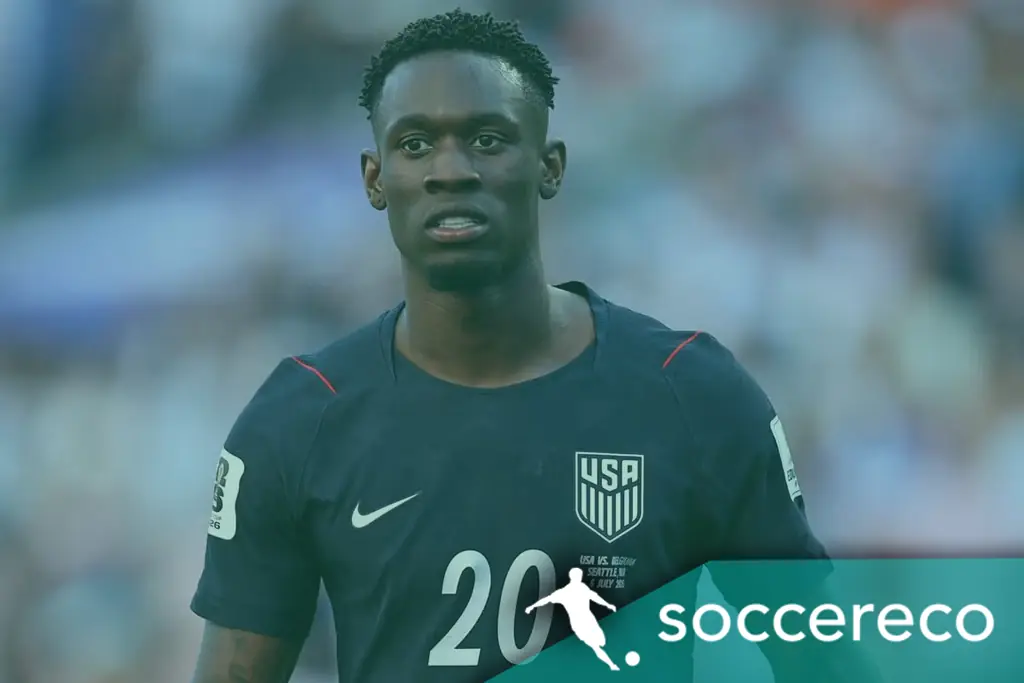
The much-discussed decision to lift the suspension of Folarin Balogun was made by just one person. This is revealed by The Times. It is another painful revelation for FIFA, which already had appearances against it.
FIFA Under Fresh Scrutiny After Balogun Suspension Was Lifted by Just One Disciplinary Official
FIFA is facing renewed criticism after reports claimed that the decision to lift the suspension of Folarin Balogun was made by just one member of its disciplinary committee. The case had already caused major debate before the United States faced Belgium, and the latest revelation has only increased questions about the process behind one of the most controversial disciplinary decisions of the World Cup.
The United States were eventually beaten 4-1 by Belgium on 07-07-2026, meaning the sporting impact of the decision was ultimately limited. But the wider issue has not disappeared. For many observers, the concern is no longer only whether Balogun should have been available for the match. It is also about transparency, consistency and the image of FIFA at a tournament where every major decision is placed under intense global scrutiny.
One Official Made the Balogun Decision
According to The Times, the decision to convert the suspension of Balogun into a suspended ban was taken by Mohammad Al-Kamali, the chairman of the FIFA disciplinary committee. The report states that Al-Kamali, who is from the United Arab Emirates, made the decision without consulting any of the other 17 members of the committee.
The newspaper notes that it is not unusual for disciplinary cases to be handled by a single member of the committee. Smaller or routine cases can often be dealt with quickly by one official, especially when the facts are considered straightforward. However, in major cases, there are usually 3 members involved.
That distinction is important. This was not an ordinary disciplinary matter hidden away in the background of the tournament. It involved a red card, a knockout-stage match, one of the host nations and a player whose availability became a major talking point before the United States faced Belgium.
For that reason, the fact that the decision was apparently taken by only one person has caused frustration. Even if the process technically allowed it, the optics are uncomfortable for FIFA. At major tournaments, the appearance of independence can be almost as important as the decision itself.
Why the Decision Caused So Much Debate
Balogun had been sent off against Bosnia and Herzegovina, and in normal circumstances a red card leads to an automatic one-match suspension. That would have ruled him out of the round of 16 match between the United States and Belgium.
Instead, the suspension was converted into a conditional punishment, allowing Balogun to take part in the knockout fixture. That immediately led to surprise and criticism, particularly in Belgium, where many felt the United States had received unusually favourable treatment.
The debate was not only about Balogun as a player. It was about whether rules were being applied consistently. In tournament football, where one match can decide the future of a team, even one disciplinary decision can become extremely sensitive.
Belgian supporters and many neutral observers questioned why a player sent off in a previous match was allowed to appear in the next round. The timing of the decision made the reaction even stronger, because it came before a high-profile match involving the host nation.
Trump Phone Call Added to the Suspicion
The controversy became even more delicate after it emerged that United States president Donald Trump had called FIFA president Gianni Infantino and asked for the suspension of Balogun to be lifted.
That detail changed the tone of the debate. What might otherwise have been seen as a strict legal or disciplinary matter suddenly became a political and reputational issue for FIFA.
Infantino later insisted that the FIFA disciplinary committee operates independently and that such decisions are not influenced by outside pressure. He also stressed that a phone call from Trump had no impact on the outcome.
However, the latest report makes that defence more difficult from a public perception point of view. If a full panel had reviewed the case, FIFA could have pointed to a broader internal process. But if only one person made the decision, critics will argue that the process looks too narrow for a matter of this importance.
That does not prove outside influence. But it does create more room for doubt, and that is exactly what FIFA did not need.
Belgium Responded on the Pitch
In sporting terms, Belgium delivered the clearest possible response. They beat the United States 4-1 and advanced with authority, removing any argument that Balogun changed the final outcome of the match.
The result gave Belgium a sense of revenge after days of frustration around the disciplinary decision. Rather than allowing the controversy to distract them, the Belgian players produced a strong performance and settled the matter on the pitch.
For Belgium, the victory was important not only because it moved them forward in the tournament, but also because it prevented the controversy from becoming the central explanation for their exit. Had the United States won with Balogun involved, the debate would almost certainly have become much bigger.
Instead, Belgium made sure the football result was decisive. Even so, the questions around FIFA remain.
FIFA Image Takes Another Hit
FIFA has often had to deal with criticism over governance, transparency and decision-making. At a World Cup, those issues become even more visible because every detail is watched by fans, federations, media and political figures across the world.
This case is damaging because it combines several sensitive elements at once. It involves a disciplinary decision, a host nation, a major player, a reported political intervention and a process that now appears to have involved only one committee member.
Even if FIFA believes the decision was made correctly under its rules, the organisation still faces a communication problem. Many football fans will not focus on technical regulations. They will simply ask why a red-card suspension was changed before a knockout match and why only one official made that call.
That is the reputational danger. FIFA may be able to defend the decision procedurally, but public trust depends on more than procedure. It depends on the belief that all teams are treated equally and that powerful nations do not receive special consideration.
Consistency Remains the Key Question
The most important question now is whether similar cases have been treated in the same way. If FIFA can show that comparable red-card suspensions have also been converted into conditional punishments, the decision may be easier to justify.
But if this case appears unusual, the criticism will continue. Football federations want certainty. Coaches want to know what punishments mean. Players want to understand the limits of discipline. Supporters want to believe that the rules do not change depending on the country involved.
That is why consistency matters so much. A one-match ban for a red card is one of the clearest disciplinary expectations in football. Any exception needs to be explained carefully and convincingly.
In the case of Balogun, that explanation has not satisfied everyone. The latest report only adds another layer of discomfort.
The Controversy May Continue Beyond the Match
On the field, Belgium moved on and the United States were eliminated. That should have been the end of the story from a sporting perspective. But disciplinary controversies often outlive the matches themselves, especially when they raise larger questions about governance.
For FIFA, the challenge is now to protect the credibility of its disciplinary system. That means making clear why the decision was made, why one official was enough in this case and whether the same approach would have been used for any other team.
If those answers are not convincing, the Balogun case may become another example used by critics who argue that FIFA needs greater transparency in its internal processes.
For Belgium, the matter is easier to leave behind. They answered in the strongest possible way by winning 4-1. For FIFA, however, the issue is less simple. The match is over, but the questions about how the decision was made are likely to remain.
A Decision That Still Leaves Doubts
The suspension of Balogun may no longer matter in terms of the tournament result, but the controversy still matters for FIFA. The issue is not only about one player or one match. It is about whether disciplinary decisions at the highest level of football are seen as independent, consistent and transparent.
When a major decision is made by a single official, especially after political attention around the case, FIFA needs to be able to explain that process clearly. Without that clarity, suspicion grows quickly.
Belgium may have taken sporting revenge on the pitch, but the wider debate is now about governance. In that sense, the Balogun case has become more than a disciplinary footnote. It has become another test of trust for world football governing body at a time when every decision is under the microscope.