Javier Tebas defended La Liga referees after criticism from Real Madrid and Jose Mourinho, rejecting claims of a conspiracy against the club.

Tebas hits back at Real Madrid over refereeing criticism
Javier Tebas has responded forcefully to the latest wave of criticism from Real Madrid and José Mourinho following the 2-1 derby defeat to Atlético Madrid, rejecting the suggestion that refereeing decisions are being systematically directed against the Spanish giants. The La Liga president entered the debate on Tuesday after Mourinho had heavily criticised the officiating team and after further complaints emerged around the way the derby had been handled. Tebas argued that mistakes by referees cannot automatically be turned into evidence of a wider conspiracy and accused those close to Real Madrid of returning to what he described as a familiar narrative whenever results or controversial decisions go against the club.
The dispute intensified after Tebas responded publicly to an article published by Spanish newspaper El Debate under the headline “Real Madrid cannot understand the interest in ruining La Liga as early as September”. Rather than limiting himself to a brief defence of the referees, Tebas challenged the premise of the article and directly questioned the idea that the competition could somehow benefit from damaging one of its biggest clubs. He also criticised arguments suggesting that the economic importance of Real Madrid should influence the way refereeing decisions are assessed, insisting that the same standards must apply regardless of the size, revenue or global audience of the team involved.
Tebas rejects conspiracy claims
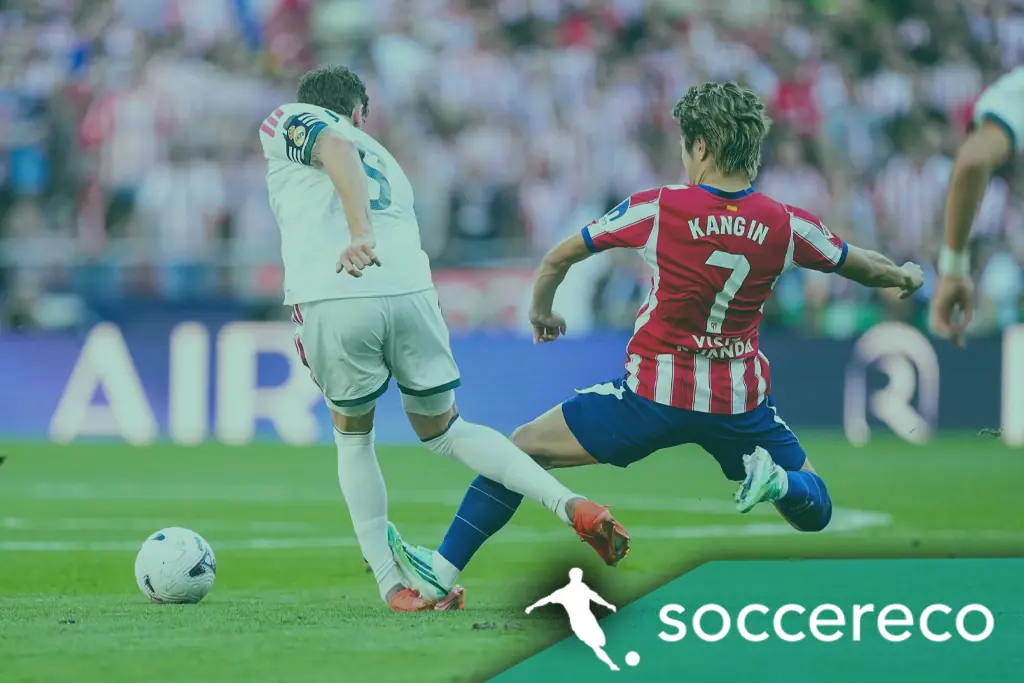
“The spokespersons and the regime television are already beginning to build the usual narrative: the permanent conspiracy,” Tebas wrote on X. “When it is not Negreira, it is the referee; when it is not that, it is the fact that he is not an international referee.” His comments were a direct response to the way the derby controversy had developed after the final whistle, with Mourinho questioning not only individual decisions but also the experience of the referee and the background of the VAR official. The Real Madrid coach had appeared at his post-match press conference with images of two incidents involving Jude Bellingham and Federico Valverde, arguing that both should have resulted in Atlético players being sent off.
Tebas pushed back against the idea that the status or profile of the appointed referee should itself be regarded as evidence that Real Madrid had been treated unfairly. He argued that all clubs can be officiated by both international and non-international referees and that no team is entitled to have appointments specifically tailored to its preferences. “Every club can be refereed by international referees and by those who are not. Nobody has the right to refereeing tailored to their needs,” he wrote. For Tebas, the debate should remain centred on whether individual decisions were correct or incorrect rather than being expanded into a theory that the competition is structurally acting against one club.
Economic importance should not influence decisions
One of the strongest parts of Tebas response concerned the suggestion that refereeing controversies could damage the commercial value of La Liga, particularly when they involve Real Madrid. He took issue with the implication that officials should somehow consider the economic consequences of decisions affecting the biggest clubs. “But this article goes even further: it argues that referees are damaging ‘the business that feeds them’. What exactly is it asking for? That matches should be refereed according to revenue, television audiences or the badge?” he asked.
Tebas acknowledged that Real Madrid are enormously important to La Liga, both commercially and internationally, but rejected the idea that this importance gives the club a different status when it comes to the rules of the competition. He also objected strongly to any suggestion that La Liga would be worthless without Madrid, arguing that such a view diminishes the history and relevance of every other club involved. “Real Madrid are enormously important to La Liga. But claiming that ‘La Liga is worth nothing’ without them shows contempt for the other clubs, their supporters and their history. The competition does not belong to anyone,” he said.
That point goes to the heart of Tebas argument. His position is that the value of Spanish football cannot be reduced to one institution, however powerful or successful that institution may be. From his perspective, treating Real Madrid differently because of their international reach would undermine the principle of sporting equality rather than protect the league. He therefore framed the dispute not simply as a disagreement over two controversial decisions in the Madrid derby but as a broader debate over whether major clubs should expect a different form of institutional treatment.
Mourinho had launched fierce attack after derby
Tebas intervention came after Mourinho had delivered one of his strongest attacks on Spanish refereeing since returning to Real Madrid. Following the 2-1 defeat to Atlético, the Portuguese coach arrived at his press conference carrying printed images of the incidents involving Bellingham and Valverde. He described them as “two clear red cards” and said they represented “the story of the game”. Mourinho also questioned whether the referee had sufficient experience to handle such a high-profile derby and criticised the appointment of the VAR official.
The incident involving Valverde became even more significant after Real Madrid later confirmed that the Uruguay international had suffered severe trauma to his left ankle. Mourinho had already argued that the challenge on Valverde deserved a sending-off, while the club subsequent medical update ensured that the tackle remained at the centre of the post-match discussion. The coach also pointed to the challenge on Bellingham as another incident in which he believed Atlético should have been reduced to ten men.
Mourinho did stop short of directly claiming the game had been deliberately manipulated, saying he preferred to believe the officials and the appointments committee had simply made mistakes. However, he also referred to previous refereeing controversies, questioned the background of the VAR official and invoked the Negreira case during his press conference. Those comments ensured the discussion quickly moved beyond the specific derby incidents and into the broader debate over trust in Spanish refereeing.
Tebas says mistakes are not proof of manipulation
Tebas was particularly critical of the way individual refereeing errors are, in his view, repeatedly used as evidence of an organised campaign against Real Madrid. “To argue that referees are being directed against Real Madrid is to live in another galaxy,” he wrote. The La Liga president did not claim that officials never make mistakes. Instead, his argument was that the existence of mistakes is not sufficient to prove that those mistakes are intentional, coordinated or designed to influence the competition.
“One refereeing mistake does not prove a conspiracy, and repeating it for years does not make it true,” Tebas added. That distinction is central to his defence of the refereeing structure. Referees can be criticised for individual decisions and controversial incidents can be reviewed, but Tebas rejects the step from identifying an error to claiming systematic bias. In his view, persistent repetition of that allegation does not strengthen the evidence behind it.
He also suggested that concentrating on refereeing controversies risks distracting from problems that may exist within Real Madrid own performances. “That narrative serves as an excuse to hide other weaknesses that everyone can see in these opening matches of the season. It is easier to point to a conspiracy than to explain what is happening on the pitch,” Tebas wrote. That was one of his clearest challenges to Mourinho and those defending the club, arguing that the derby result should also be analysed through footballing performance rather than being reduced entirely to refereeing decisions.
Long-running tensions resurface
The confrontation is another example of the difficult relationship between Tebas and Real Madrid, with disagreements between the La Liga president and the club having frequently moved beyond isolated matches or refereeing controversies. In this case, however, Tebas focused his response specifically on the language being used around the derby and the suggestion that the league itself was being damaged intentionally at such an early stage of the season.
His tone was unusually sharp. “TAKE THE BLINDFOLD OFF!” he wrote in capital letters before pointing out that the season is only in September. “We are in September and they are already claiming the league has been manipulated. The same old excuse no longer convinces anyone with common sense.” The message was designed to reject the idea that a handful of early-season refereeing controversies can already be used to question the integrity of the entire competition.
That does not mean the original incidents will disappear from discussion. The challenges on Bellingham and Valverde will continue to be analysed, particularly because Mourinho presented images to support his interpretation and because Valverde was subsequently diagnosed with a serious ankle trauma. What Tebas is contesting is the broader conclusion drawn from those incidents. His argument is that even if officials made mistakes, that does not demonstrate a deliberate effort to harm Real Madrid.
Debate now goes beyond the derby
What began as a dispute over two tackles in a 2-1 Atlético victory has therefore developed into a much larger confrontation involving Mourinho, Real Madrid, the refereeing authorities and the president of La Liga. Mourinho has framed the issue as one of fairness and equal conditions, while Tebas has responded by accusing Madrid-linked voices of repeatedly falling back on conspiracy claims whenever controversial decisions arise.
The disagreement also highlights how quickly refereeing debates in Spanish football can expand beyond the match itself. Once Mourinho raised questions about the referee experience, VAR history and the Negreira case, the discussion moved from disciplinary decisions to the credibility of the wider system. Tebas answer followed the same path in reverse, defending the structure as a whole while acknowledging that individual refereeing mistakes can happen.
For Atlético, the sporting reality remains straightforward: they won the derby 2-1. For Real Madrid, the result has become inseparable from the two incidents Mourinho believes should have changed the match. And for Tebas, the key point is that neither a controversial derby nor a refereeing mistake should automatically be treated as evidence that La Liga is acting against its most internationally recognised club.
Tebas refuses to soften his position
There was little attempt at diplomacy in Tebas final message. He did not merely defend the officials or ask for calm. He directly challenged the credibility of the accusations and argued that the narrative surrounding Real Madrid is being used to avoid discussion of other sporting weaknesses. His use of phrases such as “another galaxy”, “permanent conspiracy” and “the same old excuse” made clear that he considers the debate repetitive rather than new.
The confrontation is therefore unlikely to end with one social media post. Real Madrid and Mourinho have already made their position clear, while Tebas has responded with equal force. The refereeing authorities may still face questions over the individual decisions from the derby, but the wider disagreement now concerns something more fundamental: whether refereeing controversies should be interpreted as isolated mistakes or as evidence of systematic treatment.
Tebas answer could hardly have been more explicit. He accepts that officials can make errors, but rejects the suggestion that those mistakes prove a campaign against Real Madrid. He also insists that the economic power and international importance of the club cannot become a reason for different treatment. With the season still only in September, the football may have only just started, but one of the most familiar institutional battles in Spanish football is already fully underway.