The crisis surrounding Real Madrid reached a new boiling point after the 2-0 win over Real Oviedo. In a hostile and tense atmosphere at the Bernabéu, players were whistled, banners appeared against president Florentino Pérez, and Kylian Mbappé personally created fresh unrest after the match with a series of striking comments about coach Álvaro Arbeloa.
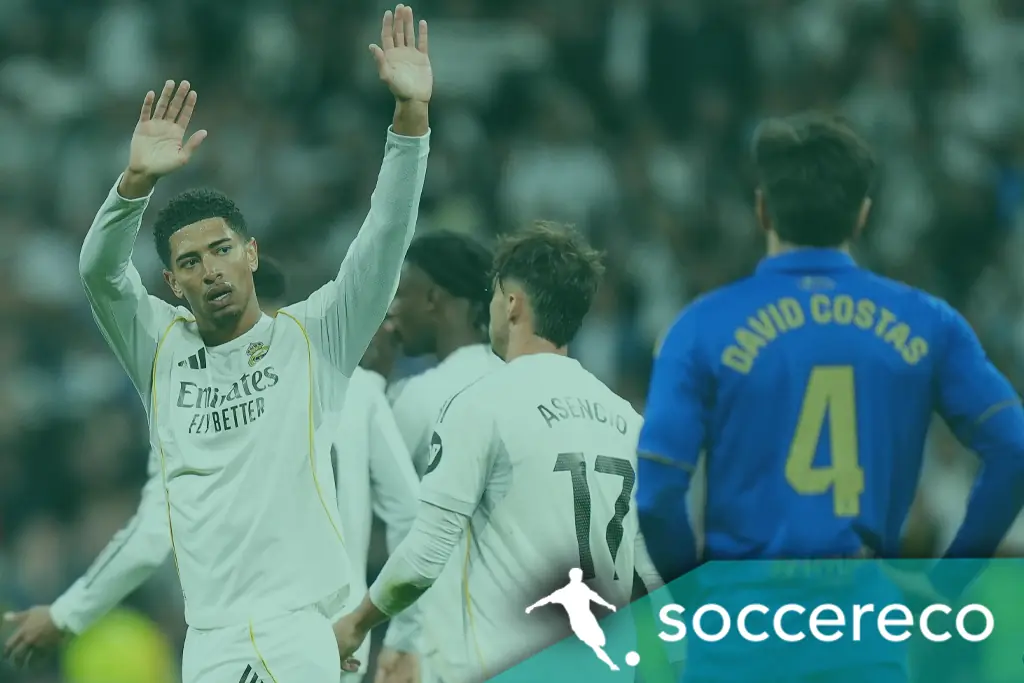
Real Madrid win fails to calm Bernabéu anger as Mbappé and Arbeloa tension dominates headlines
Real Madrid beat Real Oviedo 2-0 at the Santiago Bernabéu, but the result did little to ease the growing sense of crisis around the club. On paper, it was a straightforward victory against an already relegated opponent. Gonzalo García and Jude Bellingham scored the goals, Real Madrid controlled the match for long spells and the 3 points were secured without major difficulty. Yet by the final whistle, the football itself had almost become secondary.
In Spain, the main story was not the scoreline. It was the atmosphere. It was the noise from the stands, the whistles aimed at players, the visible anger against Florentino Pérez and the increasingly strained relationship between Kylian Mbappé and Álvaro Arbeloa. What should have been a routine home win instead became another uncomfortable chapter in a season that has left Real Madrid divided, tense and searching for answers.
The Bernabéu was far from united. Large sections of the crowd made their frustration clear, and the tension could be felt long before the final whistle. Supporters whistled moments of slow possession, reacted nervously to mistakes and showed that their patience with the current state of the club has almost disappeared. For many fans, the win over Oviedo was not enough to cover the deeper problems that have been building for weeks.
Mundo Deportivo described the scene as the night when the Bernabéu finally spoke. The newspaper focused on the banners displayed in both the north and south stands, with messages blaming Florentino Pérez and calling for him to resign. The banners were removed almost immediately by security, but the image had already been seen. The message had already reached the pitch, the directors box and the rest of Spanish football.
The removal of those banners only added to the sense of confrontation. For critics of the Real Madrid president, it was another example of a club that wants to control the message around its own crisis. The newspaper argued that Pérez allows socios to speak, but not all of them, drawing a comparison with the way certain journalists have also been treated. That line captured the mood of a night in which the frustration was not only about results, but also about power, silence and the feeling that dissent inside the club is being managed rather than heard.
The interviews given by Pérez this week were also part of the wider context. The president attempted to defend the direction of the club and present an image of control, but the reaction inside the stadium suggested that many supporters are not convinced. The Bernabéu did not simply react to one bad performance or one disappointing result. It reacted to a broader feeling that the project has lost clarity at the most important moment of the season.
That is why the 2-0 victory felt so strange. Real Madrid did what it had to do on the pitch, but the emotional temperature around the club did not drop. Gonzalo García gave the team energy and purpose, Bellingham once again showed personality in a complicated environment, and the team avoided an embarrassing result. Still, the stands were watching something bigger than a match against Oviedo. They were judging the present and the future of the club.
After the game, the focus quickly moved to Kylian Mbappé. AS placed special emphasis on the words of the French forward, describing him as a player who wanted to speak, wanted to send a message and wanted to leave nothing unanswered. His comments did not calm the situation. They opened another front in a club already surrounded by tension.
The relationship between Mbappé and Arbeloa has become one of the most sensitive issues at Real Madrid. According to the Spanish press, the bond between the star player and the coach has been damaged by a series of episodes that slowly turned disagreement into open discomfort. What once looked like a normal sporting debate has developed into something much more serious, because it now involves authority, status and the direction of the dressing room.
The biggest rupture reportedly came before El Clásico, when Mbappé discovered that he would not start the match. That decision was always going to carry enormous weight. Leaving out a player of his profile in a fixture of that magnitude was not just a tactical call. It was a statement of hierarchy. For Arbeloa, it may have been about discipline, physical condition or balance. For Mbappé, it appears to have been received as a direct challenge to his role within the team.
From that moment, the situation deteriorated quickly. AS reported that Mbappé left training in the final minutes because of alleged physical discomfort and was then mysteriously absent from the match squad. Whether that absence was purely medical, disciplinary or a mixture of both has become part of the debate. In Madrid, uncertainty often creates more noise than certainty, and this case has been no different.
A second important moment came after the 2-0 win over Espanyol at the RCDE Stadium. Arbeloa was asked several times about Mbappé, who had reportedly arrived by private jet from a controversial holiday in Italy shortly before kick-off and was still injured. The coach responded with a pointed comment, saying that Real Madrid is not for players who walk onto the pitch in a tuxedo. It was a phrase that immediately stood out because of its tone and because of the target everyone assumed it had.
At the time, that comment was seen as the only public dig from Arbeloa. Inside the club, however, it was interpreted by many as a sign of the tension that was already growing behind closed doors. Coaches at Real Madrid are expected to manage stars, but they are also expected to protect the institution. Players of Mbappé status expect trust, respect and a central role. When those two expectations collide, the club can very quickly become unstable.
The problem for Real Madrid is that this is no longer only about one player and one coach. It is about the entire structure around them. Supporters are angry with the president, the dressing room appears restless, the media are following every gesture and every sentence, and the sporting project looks less secure than it did only a few months ago. In that kind of environment, even a normal substitution or a short answer in a press conference can become a major controversy.
Mbappé arrived at Real Madrid carrying enormous expectations. He was not signed to be just another attacking option. He was brought in to lead a new era, decide the biggest matches and become the face of the team. That makes any disagreement involving him more explosive. If he feels that the coach does not fully trust him, the story immediately becomes bigger than football. If the coach feels that the player is not fully aligned with the demands of the club, the situation becomes equally dangerous.
Arbeloa, for his part, is dealing with one of the most difficult jobs in European football. Managing Real Madrid means dealing with results, egos, politics and constant public pressure. A coach can survive tactical criticism, but it is much harder to survive the perception that the dressing room is divided or that the stars are not fully behind him. The situation with Mbappé now threatens to become a referendum on his authority.
The Bernabéu reaction against Pérez adds another layer to the crisis. When supporters turn their frustration toward the president, the issue goes beyond the coach and the players. It becomes institutional. The banners demanding change showed that part of the fanbase believes the problems are not limited to what happens on the pitch. They see a club that needs decisions, clarity and accountability.
That is why the win over Oviedo may be remembered less for the goals and more for the atmosphere around them. Gonzalo García and Bellingham gave Real Madrid the result it needed, but they could not give the club peace. The whistles, the banners and the post-match comments from Mbappé created a much louder story than the final score.
Real Madrid now faces a delicate period. The club must decide whether to publicly project unity or confront the problems directly. Pérez must deal with visible unrest from supporters. Arbeloa must prove that he still has control of the dressing room. Mbappé must show whether he is fully committed to the collective project or whether the tension with the coach will continue to dominate the conversation.
For now, the feeling in Madrid is that the victory over Real Oviedo solved nothing. It added 3 points, but it did not remove the doubts. It gave the team a result, but it did not restore trust. The Bernabéu spoke, Mbappé answered in his own way, and Arbeloa now finds himself at the centre of a storm that is no longer easy to contain.
Real Madrid won 2-0, but the night belonged to the crisis. In a club where silence is rarely accidental and every gesture is studied, this was a match that exposed much more than a league table can show. The road to the clash between Mbappé and Arbeloa now appears clearer than ever, and unless the club acts quickly, the next chapter may be even more damaging than the last.