His goal kicks regularly sailed out over the touchline. But behind PSG goalkeeper Matvei Safonov’s absurdly poor passing accuracy on Wednesday evening was not a lack of ability, but a tactical calculation that worked.
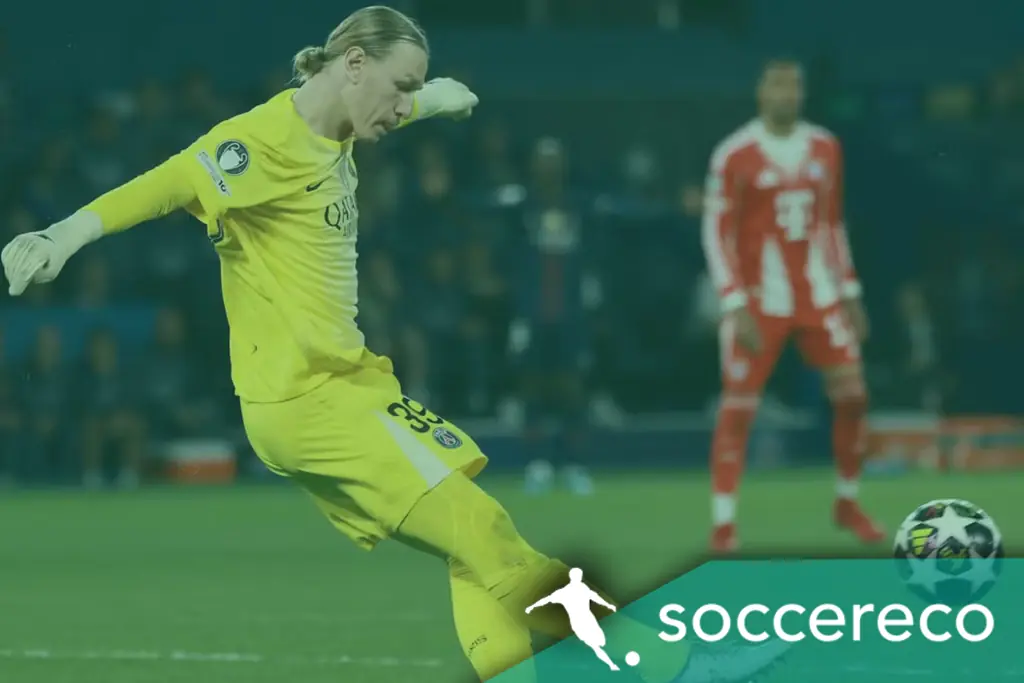
Why Safonov kept sending goal kicks out of play and why it made sense for PSG
At first, it looked almost embarrassing. Matvei Safonov stood over another goal kick in Munich, looked up, took his run-up and sent the ball sailing towards the touchline. Not once, not twice, but again and again. Inside the Allianz Arena, the reaction was immediate. The Bayern supporters laughed, applauded ironically and treated each misplaced kick as another sign that the Paris Saint-Germain goalkeeper was having a nightmare with the ball at his feet.
On the surface, it was easy to understand that reaction. This was a Champions League semi-final, one of the biggest stages in club football, and PSG had a goalkeeper repeatedly giving the ball away in a manner that looked almost amateurish. In an era in which elite teams demand goalkeepers who can pass under pressure, break lines and act almost like an extra centre-back, Safonov appeared to be doing the exact opposite. His passing numbers told a brutal story. He took 13 goal kicks, only two of them found a teammate, and six flew directly out over the touchline. When all his passes were counted, his completion rate was just 21.2 percent.
For a player completing the full 90 minutes in a Champions League match, that number was historically poor. It was the weakest figure for almost four and a half years, since Geronimo Rulli produced an even lower rate for Villarreal against Atalanta in December 2021. Compared with Manuel Neuer, who finished the same evening with a pass completion rate above 70 percent, Safonov looked, statistically at least, like a goalkeeper from another level entirely.
But football numbers can mislead when they are stripped of context. Safonov was not simply panicking. He was not just technically out of his depth. He was not repeatedly miscuing basic restarts because he had forgotten how to kick a football. The more often the pattern repeated, the clearer it became that there was method behind the apparent chaos. PSG were not losing control through poor execution. They were, in their own way, trying to control the match by choosing exactly where the next phase of play would begin.
That distinction is crucial. A bad pass gives the opponent a chance to attack from an unpredictable position. A planned kick into touch gives the defending team time to reorganise, push up the pitch and prepare for a situation they have already rehearsed. It looks ugly, and it damages the individual statistics of the goalkeeper, but it can serve the collective structure of the team. For Luis Enrique, that is usually the point. The PSG coach has never been interested in football that only looks elegant. He is obsessed with control, spacing, repeatable patterns and the reduction of randomness.
This is why Safonov goal kicks must be seen less as a failure of technique and more as an extension of the tactical identity that PSG have been building under Luis Enrique. The Spanish coach wants his team to dominate not only with the ball, but also around the ball. He wants PSG to know where to stand, where to press, where to trap the opponent and how to turn supposedly neutral situations into moments of advantage. Throw-ins, kick-offs and goal kicks are not dead time for him. They are part of the game plan.
The comparison with the PSG kick-off routine is especially revealing. Since last season, PSG have used a striking tactic in several important Champions League matches. From their own kick-off, the ball is played backwards to Vitinha, who then drives it long towards the touchline, ideally deep in the opposition half and close to the corner flag. To many viewers, it can look like PSG are wasting possession immediately. In reality, they are choosing field position over sterile ball retention.
The logic is simple but clever. By sending the ball out of play high up the pitch, PSG can push their entire team into the opposition half. The opponent then has a throw-in close to their own corner, with limited angles, limited space and limited time. A throw-in is technically possession, but it is often one of the hardest situations from which to build cleanly. The player taking the throw has no option to play backwards to himself, the receiving players are usually tightly marked, and the touchline acts as an extra defender. PSG deliberately give the ball away because they believe the next few seconds will belong to them.
Safonov goal kicks followed the same philosophy. Instead of trying to find a teammate under difficult conditions, or launching the ball towards aerial duels that PSG were unlikely to dominate, he sent the ball towards areas where Paris could prepare their press. If the ball went out near the halfway line or deeper into Bayern territory, PSG could squeeze the pitch, push their midfield forward and challenge the restart aggressively. The ball was gone, but the structure remained.
This matters even more because of the profile of the PSG team. Luis Enrique does not have, and does not particularly seek, a traditional towering striker who can act as a target for long goal kicks. PSG are not built to launch balls towards a centre-forward who can wrestle with Jonathan Tah or Dayot Upamecano, win the first contact and bring runners into play. Their strengths are different. They want speed, counter-pressing, combinations in tight zones, aggressive defensive reactions and technical players arriving around the ball. A hopeful long kick into the centre of the pitch would probably have produced a 50-50 duel, or worse. A deliberate kick into touch created a more predictable battlefield.
That is why the poor passing percentage tells only part of the story. In a conventional reading of the match, a goalkeeper completing just 21.2 percent of his passes has performed terribly. In a tactical reading, the question is different. Did PSG suffer from those restarts, or did they use them to force Bayern into uncomfortable situations? Did Safonov make random mistakes, or did he repeatedly execute a specific instruction? Did PSG lose territory, or did they manipulate where Bayern had to restart the game?
The answer is not that every kick was perfect. Some looked rough, and the visual impression was undeniably strange. There were moments when Safonov looked like a goalkeeper inviting ridicule. Yet elite football is full of actions that look odd when viewed in isolation. A defender allowing a ball to roll out rather than clearing it can look passive, but it may be the right choice. A midfielder refusing a forward pass can look negative, but it may preserve the structure. A goalkeeper kicking deliberately into touch can look technically weak, but it may be the most rational option available.
There is also a psychological element. Bayern, at home, with the crowd pushing them forward, would naturally want rhythm. They would want to press Safonov, force him into hurried short passes and turn every PSG restart into a moment of panic. By removing the build-up phase and sending the ball out, PSG denied Bayern that exact type of emotional momentum. The crowd could laugh, but the game did not necessarily open up. Bayern got throw-ins, not immediate transition attacks through central areas. PSG accepted the mockery because they preferred the structure.
For Safonov personally, this was not an easy role to accept. Goalkeepers are judged harshly by visible errors and basic statistics. A pass completion rate that low will follow a player around, especially in a Champions League semi-final. Many viewers will not study the tactical logic behind the numbers. They will simply see a goalkeeper who could not find a teammate. That makes his performance unusual in another sense: it required a player to sacrifice individual optics for the collective plan. In modern football, where every data point is instantly shared and judged, that is not insignificant.
The irony is that PSG were once criticised for having a goalkeeper situation that did not fully match the demands of elite possession football. Gianluigi Donnarumma, one of the best shot-stoppers of his generation, was often questioned for his distribution. Luis Enrique wanted more security and more precision from the back. On paper, then, it seems bizarre to watch a PSG goalkeeper in a semi-final complete barely one pass in five. But the contradiction is only apparent. Luis Enrique does not want passing for the sake of passing. He wants the solution that gives PSG the greatest control over the next phase. Sometimes that means short build-up. Sometimes it means drawing pressure. And sometimes, as Munich showed, it means deliberately putting the ball into touch.
This is where the evolution of elite football becomes fascinating. Coaches are increasingly searching for marginal gains in areas that were once treated as secondary. Throw-ins, kick-offs, restarts and defensive pressing traps are now designed with the same level of detail as attacking patterns. The game is no longer only about who has possession, but about where possession begins, how the opponent receives it, what direction they are facing and how quickly pressure can arrive. PSG approach under Luis Enrique reflects that broader shift.
In old football language, giving the ball away was almost always seen as a mistake. In current elite football, giving the ball away can be a strategy, provided the team controls the conditions of the giveaway. There is a major difference between losing the ball in midfield with players spread across the pitch and sending it out of play in a zone where the entire team is ready to press. PSG were not surrendering control. They were redefining what control meant.
That does not mean the tactic will become universally popular or even universally effective. It depends on the quality of the pressing team, the organisation after the restart, the physical capacity to squeeze the pitch and the opponent ability to escape pressure. Against a team with outstanding throw-in routines or exceptional press resistance, the same idea could backfire. If the receiving team breaks the first line, the side that deliberately kicked the ball out may suddenly find itself exposed. Like every tactical tool, it only works when the execution after the initial action is sharp.
But in Munich, the pattern made sense. PSG were not looking for aesthetic approval. They were looking for control, territory and pressure. Safonov became the most visible symbol of that approach because his numbers looked so poor. Yet the ugly statistics were part of a wider tactical picture. The goalkeeper was not the weak link in a broken plan. He was the starting point of a very specific plan, one that asked him to do something that would look bad to almost everyone watching.
That is perhaps the best way to understand the strange spectacle at the Allianz Arena. The ironic applause from the stands was not unreasonable. From the seats, each kick into touch looked like another technical failure. But from the PSG bench, those same kicks may have looked like controlled entries into rehearsed pressing situations. The crowd saw waste. Luis Enrique saw territory. The statistics saw missed passes. PSG saw predictable restarts.
In the end, Safonov evening was a reminder that modern football is often more complex than it appears in real time. A goalkeeper can produce one of the worst passing percentages seen in the Champions League for years and still be following the instructions of a meticulous coach. A team can deliberately give away possession and still be acting from a position of tactical confidence. A sequence that looks absurd can, on closer inspection, reveal the logic of a team trying to control every possible detail.
So the question at the start, what is a goalkeeper like that doing in a Champions League semi-final, has a very different answer by the end. Safonov was not there to impress with clean passing numbers. He was not there to satisfy the crowd or protect his individual statistics. He was there to execute the PSG plan, however strange it looked. And on a night when every detail mattered, even a goal kick into touch could become a weapon.