
Aston Villa are in blistering form. On Sunday evening, the Birmingham side secured their seventh consecutive Premier League victory against Manchester United. In an entertaining match at Villa Park, two incredible goals from Morgan Rogers proved decisive.
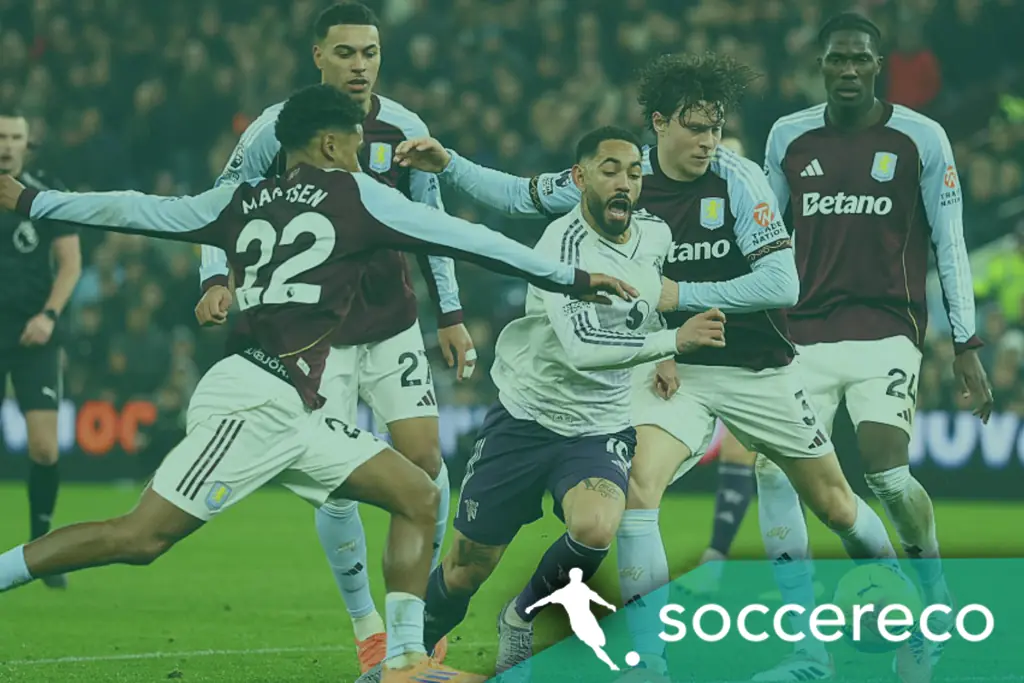
Aston Villa continued their outstanding run of form with a 2-1 victory over Manchester United today, a result that further strengthens their position among the Premier League’s pace-setters and underlines how difficult Villa Park has become for visiting sides.
With Morgan Rogers scoring twice and Villa showing both flair and resilience, Unai Emery’s team once again delivered a statement performance at a key moment in the season.
Emery made a notable selection call by starting Ian Maatsen at left-back, choosing the Dutchman ahead of Lucas Digne. That decision meant Maatsen was the only Dutch player in the starting line-up, with Marco Bizot, Lamare Bogarde and Donyell Malen beginning the match on the bench. Across the technical area, Rúben Amorim also had important choices to make. He named a starting team without Joshua Zirkzee and Tyrell Malacia, while Matthijs de Ligt was ruled out through injury, limiting United’s options and forcing adjustments to their structure.
The opening phase immediately set the tone for a lively contest. Both sides looked capable of striking early, and the match carried a high tempo from the first whistle. Villa found space on transitions and pushed numbers forward whenever they recovered possession, while United tried to move the ball quickly through midfield and use the pace of their forwards to threaten behind the defensive line.
The first major Villa chance arrived after a swift break, with John McGinn finding himself in a promising position and forcing United to scramble. Moments later, Morgan Rogers produced a piece of improvisation that nearly brought the stadium to its feet, meeting the ball with a clever backheel that crashed against the post. That sequence encapsulated how Villa approached the game: direct when needed, but always willing to take risks in the final third.
United responded with opportunities of their own, and their clearest opening in the first half fell to Benjamin Sesko. The summer signing was presented with a golden chance when a deep ball from Bruno Fernandes ran through into space, but Emiliano Martínez stood firm and made the save, ensuring Villa remained level. It was the kind of moment that can swing a big match, and Martínez’s intervention proved vital given how the rest of the half unfolded.
As the first period progressed, it began to look as if the two teams might reach the interval level, but the final moments before half-time delivered a dramatic double twist. Villa struck first with a goal worthy of the occasion. Rogers, under pressure near the touchline, somehow kept the ball in play, shifted his body inside and then unleashed a thunderous finish into the far top corner. The technique was outstanding, the execution even better, and Villa Park erupted. Scoring just before the interval is often a psychological boost, and in this case it felt like the perfect reward for Villa’s bright start and attacking intent.
However, Manchester United showed they could land a late blow of their own. In first-half stoppage time, Matty Cash was dispossessed by Patrick Dorgu, and the Danish wingback reacted instantly, sliding Matheus Cunha through into a one-on-one. The Brazilian held his nerve and beat Martínez from a tight angle, dragging United back to 1-1 and changing the mood heading into half-time. What looked set to be a Villa advantage at the break became a match reset, and the second half promised more twists.
There was a concern for United before the interval when Bruno Fernandes appeared to pick up an issue, and after the restart that worry became a major setback. Fernandes did not return for the second half, remaining in the dressing room, and Amorim reshuffled by sending on Lisandro Martínez. With the former Ajax defender moved into midfield alongside Manuel Ugarte, United effectively added an extra layer of protection in front of the back line, looking to reduce the space Villa had been finding between the lines and to slow down transitions into dangerous areas.
But if the change was designed to shut the door, Rogers found a way to force it open again. Villa continued to play with clarity and confidence, circulating the ball patiently when necessary and then accelerating sharply into the box when the moment appeared. Ollie Watkins, once again central to so much of Villa’s attacking play, provided the platform for the decisive moment. Inside the penalty area he teed up Rogers, and the winger finished with a strike reminiscent of his first goal, completing his brace and restoring Villa’s lead at 2-1. It was a forward move built on timing and composure, and a finish delivered by a player enjoying a remarkable night.
Rogers’ influence did not end there. With United forced to chase the game, spaces began to appear, and Villa looked increasingly capable of punishing them on the break. Rogers had opportunities to push for a hat-trick, repeatedly getting into dangerous shooting positions and keeping United’s defenders under constant pressure. Even when he did not get the final shot away, his movement and directness kept pulling the defensive shape out of alignment, opening lanes for Villa’s other attackers.
United, to their credit, still had a path back into the match, and their biggest chance in the second half came midway through the period. Cunha, already on the scoresheet, rose completely unmarked to meet a pinpoint cross from Dorgu, but his header drifted wide. It was the kind of chance that often decides outcomes at this level, and United’s inability to convert it left them with an increasingly difficult task as the game moved towards its closing stages.
Amorim responded by turning to his bench. Joshua Zirkzee was introduced as United searched for a leveller, adding a different profile in the final third and offering a more physical presence. Alongside that change, the match also brought a milestone moment: Jack Fletcher made his debut. The eighteen-year-old midfielder is the son of former United player Darren Fletcher, who spent more than twelve years in the club’s first team in the early two thousands, and his introduction was one of the few positives United could take from a frustrating evening.
In the final phase, United continued to press forward, but Villa’s defensive organisation held firm. Emery’s side managed the closing minutes with maturity, controlling key spaces, clearing crosses and preventing the kind of chaos United were hoping to create. Fellow teenager Shea Lacey also made his first appearance for United late on, but the visitors could not find the breakthrough they needed. When the final whistle went, it confirmed a significant result: United’s first Premier League defeat in five matches, and another victory that strengthens Villa’s growing reputation as one of the league’s most consistent sides.
Emery also drew from his own bench in the second half, bringing on Donyell Malen and Lamare Bogarde to add fresh legs and ensure Villa maintained their intensity and structure during the run-in. Those substitutions helped Villa keep control of the contest and see out the game without surrendering clear chances in the dying moments.
The broader picture is what makes this win feel even more meaningful for Villa. This result reinforces their superb form heading into the festive period, with seven straight Premier League victories now on the board. When including the Europa League, Villa have won ten consecutive matches in all competitions, a run that speaks to consistency, squad depth and a clear tactical identity. With leaders Arsenal only three points ahead and the gap to fourth-placed Chelsea double that, Villa’s position is not merely impressive, it is increasingly credible in title-race terms.
For Manchester United, the defeat leaves them in seventh place, three points behind Chelsea, and it also raises questions about how quickly they can stabilise performances against the league’s in-form sides. The absence of Matthijs de Ligt and the second-half loss of Bruno Fernandes were significant factors, but Villa’s quality, particularly through Rogers, was ultimately decisive.
Villa Park has seen many big nights, and this felt like another step in the evolution of Emery’s project. With confidence high, momentum building and key players delivering in decisive moments, Aston Villa go into the coming fixtures looking every bit like a team capable of sustaining a genuine challenge at the top end of the table.