Jamie Carragher has serious concerns about the current state of Liverpool. In his view, Arne Slot’s team took another step backwards against Sunderland. The English media are also critical of the struggling champions, with Virgil van Dijk playing a negative leading role.
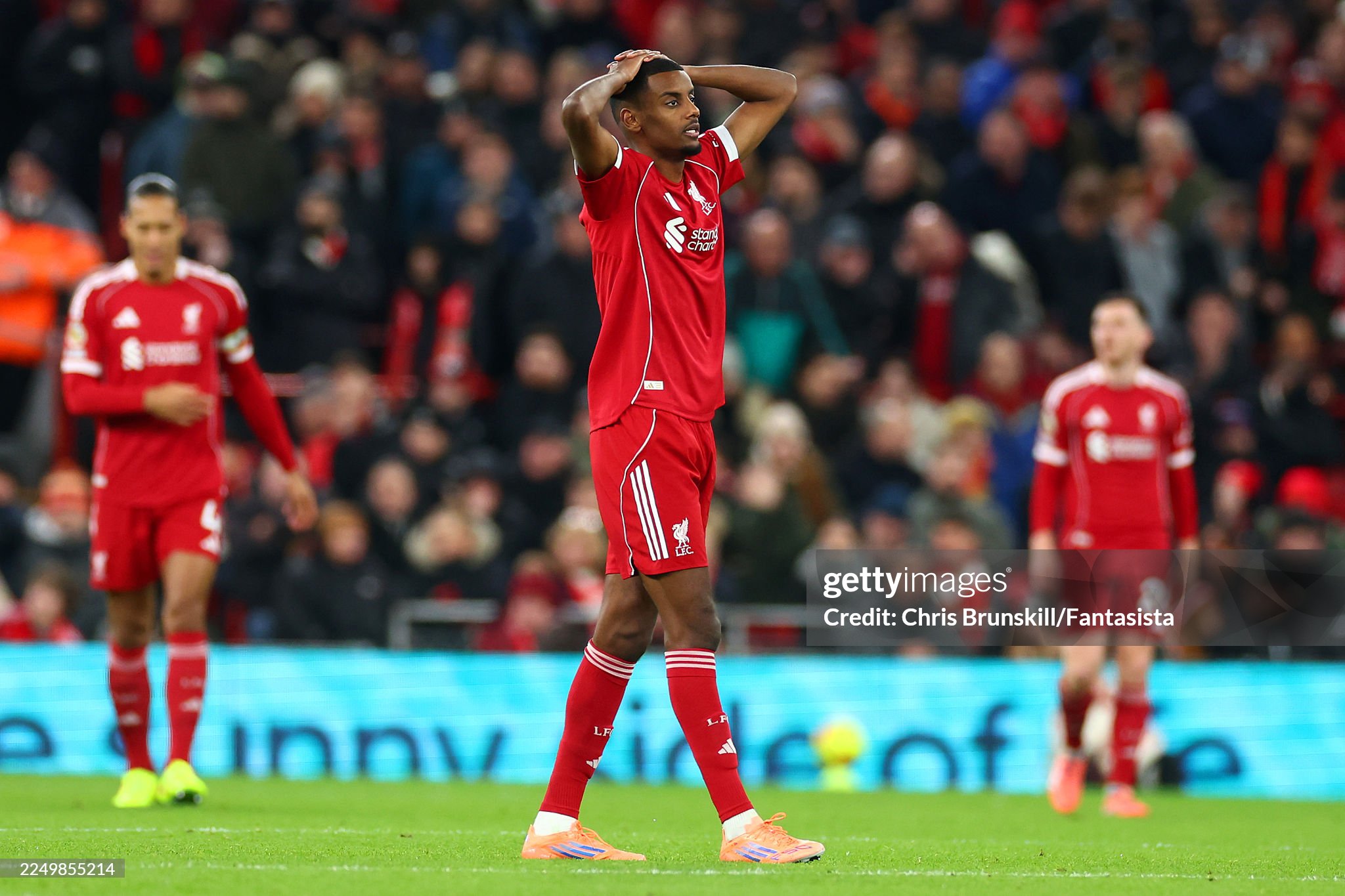
Liverpool were held to a 1-1 draw at home to Sunderland. After that stalemate, Slot himself still pointed to some positives, but the English media are far less optimistic now that Liverpool, after the liberating win over West Ham United last Sunday, have dropped points again in the Premier League following earlier defeats to Manchester City (3-0) and Nottingham Forest (3-0).
The Guardian found the performance from the Reds uninspired and The Daily Mail believes Liverpool are only getting worse.
According to the tabloid’s commentary after the home match against Sunderland, this is a team sleepwalking through a lost season, at least in the league. In its view, Liverpool are out of the title race, with the gap of eleven points to Arsenal simply too big, and the team is not good enough anyway. There is still a belief that Liverpool can turn this around and that everything might suddenly click, but at the moment what is being seen is a side that has lost its way and a manager who no longer seems to have the answers.
According to The Daily Mail, Slot has lost his magic. His decisions are no longer working out and the flashes of magic that still appear in every match seem more like luck than judgment. The paper sees Liverpool only getting worse and notes that right now every team can get something from a game against Slot’s side. The fact that a point at Anfield felt like a missed opportunity for Sunderland says it all, according to The Guardian. Federico Chiesa prevented a victory by clearing a Wilson Isidor effort off the line.
Carragher is also very worried. This feels like a step backwards, said the former Liverpool defender in his role as co-commentator for Sky Sports. There was a lack of energy, tempo and power. Liverpool were dreadful. They sleepwalked their way through the game, said Carragher about the first half. Sunderland were much sharper. Fellow analyst Daniel Sturridge sees that Slot is still searching. He does not know what his best eleven is. The players still need to get fit and find their rhythm, and the coach is looking for stability.
The fact that star player Mohamed Salah once again started on the bench and that Van Dijk, as captain, played a negative leading role in Sunderland’s 1-0 says a lot about Liverpool’s current state, according to the BBC. The harsh reality is that their level has dropped alarmingly, the broadcaster states in its analysis. Van Dijk is not being helped by the dip in form of Ibrahima Konaté and by Milos Kerkez, who has not yet settled at left back, but the big Dutchman is struggling himself as well. He is no longer a shadow of his former self.
The way Van Dijk turned his back to the ball at Sunderland’s goal speaks volumes, according to the BBC. It is a bad habit of his that sometimes costs Liverpool dearly. Of course, he was also a bit unlucky, but a defender of his class should have intervened. Jamie Redknapp, an analyst for Sky, agreed with that view. He has to go for the ball here. Last season Van Dijk could do no wrong and was excellent in every game, but now he is making mistakes and doubting himself.
The broader picture makes the criticism even more intense. Liverpool’s run of one win in four league games has not only damaged their title hopes, it has also eroded the aura that once made Anfield one of the most intimidating grounds in Europe. Sunderland arrived with a clear plan to frustrate, stay compact and spring forward in transition, and for long spells it worked. The visitors looked sharper in the duels, quicker to second balls and far more decisive in the final third whenever Liverpool’s high defensive line was exposed.
In possession, Liverpool often moved the ball slowly from side to side, without the usual vertical thrust that used to be the hallmark of their play. The midfield lacked balance, with creative players frequently dropping too deep to receive the ball while the front line waited for service that rarely came. When Liverpool did manage to accelerate, the moves often broke down through poor touches, misplaced passes or the wrong decision in the final action. That wastefulness only increased the anxiety in the stands and on the pitch.
Slot’s tactical choices are being scrutinised in detail. Rotating Salah again and leaving him on the bench from the start has been interpreted as a sign of uncertainty, either about the player’s physical condition or about the best attacking structure. The combination that started against Sunderland never really clicked. Wide players drifted inside into congested areas, full backs hesitated between overlapping and tucking in, and the central striker often found himself isolated between two centre backs with little support at close range.
Defensively, the issues are just as worrying. The once imposing partnership of Van Dijk and Konaté now looks vulnerable whenever teams attack with pace or play direct balls into the channels. Sunderland repeatedly targeted the space behind Liverpool’s full backs and forced the centre backs to defend running towards their own goal. It was in one of those situations that the 0-1 arrived, with Van Dijk turning away from the ball and failing to make the decisive block that, in previous seasons, seemed almost automatic for him.
Chiesa’s intervention on the line, stopping Isidor from making it 1-2 late on, underlined how close Liverpool came to a full scale crisis result. Rather than being a heroic moment in a convincing performance, his clearance has been framed as a desperate rescue act in a match where Liverpool were hanging on. For Sunderland, the post match feeling that a point at Anfield was a missed opportunity illustrates how much Liverpool’s status has shifted in the eyes of opponents. Teams no longer arrive hoping simply to limit the damage; they now genuinely believe they can win.
The mood among supporters reflects this change. Social media channels and phone ins have been filled with questions about recruitment, fitness and the identity of the team under Slot. Many fans accept that a transition period was inevitable after such an intense era under previous management, but they are struggling to identify a clear playing style or progression. The criticism is not yet unanimous, but there is a growing sense that time is no longer an unlimited resource and that visible improvement is needed quickly.
Pundits have also highlighted the psychological side of the slump. Carragher spoke about body language and mentality, pointing out that Liverpool once thrived on chaos, feeding off the energy of turnovers and high pressing, whereas now they often look fearful of making mistakes and choose the safe option. Sturridge, for his part, focused on the lack of rhythm and cohesion, noting that constant changes to the starting eleven and in game tweaks might be contributing to the players’ uncertainty.
From a purely mathematical perspective, the situation is still recoverable in terms of a top four finish, but the gap to Arsenal and other rivals at the top leaves little room for further errors. More dropped points against teams from the bottom half would not only end any faint title hopes, it could also create pressure around Champions League qualification. The financial and sporting consequences of missing out on the top European competition would be significant, which is why commentators keep stressing the urgency of the moment.
There is, however, still some mitigation in the form of injuries and fitness issues. Several key players are either returning from layoffs or still building up to full sharpness, and new signings like Kerkez are adapting to a different league, different opponents and a different level of scrutiny. Some analysts argue that, with a stable back four, a settled midfield structure and a consistent front three, Liverpool might rediscover their intensity more quickly than the current mood suggests.
Even so, the narrative after Sunderland is clear: the benefit of the doubt is starting to run out. When English media describe Liverpool as sleepwalking through the season and talk about a lost campaign in the league, they are not just referring to the league table, but to the underlying performances. The team looks fragile, the pressing looks half hearted, and the once automatic patterns of play now appear improvised and disconnected.
For Slot, the challenge is as much about communication and leadership as about tactics. He has to convince the dressing room that his ideas are still valid, persuade senior players like Van Dijk and Salah to rediscover their best form, and restore the aggressive, front foot identity that made Liverpool so feared. The coming weeks, with a demanding run of fixtures in the league and cup competitions, will likely determine whether this season is remembered as a temporary dip in a long term project or as a campaign that drifted away from them long before the final whistle of May.
Updated: 11:45, 4 Dec 2025