After the notorious fan club visit, Lennart Karl responded in his own way during Bayern’s 5-0 win in Salzburg.
Two days after a relaxed fan club moment turned into a national talking point, Lennart Karl chose the most direct route back to normality.
He went to Max Eberl's office, cautiously and with a clear sense that a small sentence had become a very big topic. "I didn't say something that good," the 17-year-old told Bayern's sporting director, a simple admission that showed he understood the difference between a private joke and a public quote.
The original scene had taken place the Sunday before during a Bayern fan club visit in Burgsinn, in Lower Franconia. These meetings are meant to be informal: players answer friendly questions, sign memorabilia, and give supporters a rare feeling of closeness. For a teenager stepping into the first team spotlight, it can feel like a safe environment, almost like an extension of youth football culture where enthusiasm is rewarded and every answer does not need a press officer.
Then came the question that is harmless on the surface, but loaded for any rising talent at a club that wants to be seen as the final destination: which dream club do you have besides Bayern. Karl smiled, praised Bayern as a very big club and a dream to play for, and then added that at some point he definitely wanted to play for Real Madrid. He finished with a line that sounded playful in the room, but became explosive once it left the room: that it should stay between them.
It did not. The exchange was filmed, spread online, and sparked outrage particularly among Bayern supporters. The criticism followed a predictable path: how can a player already be talking about leaving when he has only just become a professional. Bayern, as a brand, is built on dominance and identity, and supporters tend to react sharply when they sense that a young player views the club as a step rather than a home.
Yet the content of Karl's remark was less shocking than the timing. Many young players grow up seeing Real Madrid as the ultimate symbol of football prestige. Karl simply said the quiet part out loud, in a setting where he likely expected it would remain a harmless moment. He even has a personal reference point, having done a trial experience there when he was ten. In his mind, it was honesty and ambition. In the public arena, it was interpreted as disloyalty.
What mattered next was the club's response. According to Eberl, Bayern reacted "completely relaxed." There was no public scolding and no attempt to turn a teenage slip into a headline war. Instead, Eberl treated it as a learning moment and passed on a lesson from his own football education, recalling advice from Hans Meyer: talk about yourself and your own actions, and you reduce the risk of saying something that can be turned into a controversy.
That approach reflects how elite clubs now manage young talents. The tactical and physical development is obvious, but the off-pitch education is just as important. A modern professional is judged on performance, yes, but also on tone, loyalty signals, and emotional intelligence in public. One clipped sentence can alter how a player is framed for weeks, and once a narrative sticks, it can affect everything from crowd patience to dressing-room noise.
German football is full of these moments where words become a barometer of pressure, and the dynamics are not limited to teenagers. At the top level, the same attention that punishes a young player's casual ambition also demands clarity and standards from leaders when results wobble. That is why, elsewhere in the Bundesliga, the conversation has also shifted toward accountability, highlighted by Schlotterbeck's sharp criticism of his own teammates after a frustrating draw.
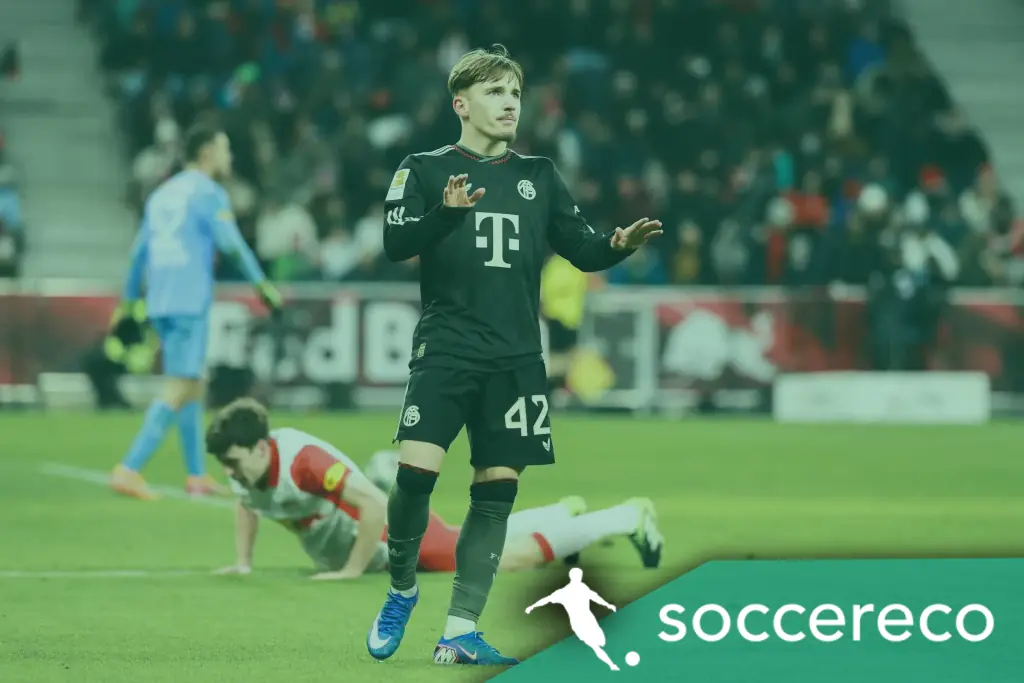
Back in Karl's case, he chose not to fight the debate with more quotes. He answered it the way footballers prefer: with actions on the pitch. In Bayern's friendly in Salzburg, he came on as a substitute and delivered an emphatic response. He scored once with his left foot, once with a header, and then provided an assist with his right for Felipe Chavez's 4-0. It was the kind of cameo that coaches love because it shows variety, composure, and the ability to influence the game in more than one way.
Even his celebration carried a message. Karl used a light, stay-relaxed gesture, an attempt to close the story quickly and move the spotlight back to football. It was subtle, but it revealed quick learning: the fastest way to end noise is to make it feel outdated by replacing it with performance.
Eberl then publicly drew a line under the episode. "For us, the matter is closed," he said, making it clear Bayern had no interest in dragging a teenager through a prolonged debate. He emphasized that a 17-year-old is allowed to make mistakes, especially in moments of excitement, and that a young player can easily say something that sounds different when replayed later. The key, in Eberl's view, is that Karl learns and keeps progressing.
The most revealing part of Eberl's assessment was about identity and visibility. Karl is no longer "Lenny," the unknown kid who can talk freely because nobody is listening. He is Lennart Karl, and now a whole country is watching what he does and what he says. That transition changes everything: the player must grow not only in technique and decision-making, but also in self-management, media awareness, and the ability to handle emotionally charged reactions without letting them change his focus.
Bayern's handling suggests they see this as an early, manageable lesson rather than a character flaw. They did not deny Karl's ambition, because ambition is normal at that age and often necessary to reach the top. They simply redirected him toward maturity, reminding him that how you speak can either protect your path or complicate it. For Karl, the message is simple: the talent is obvious, the future is open, but the present demands discipline in both football and communication.