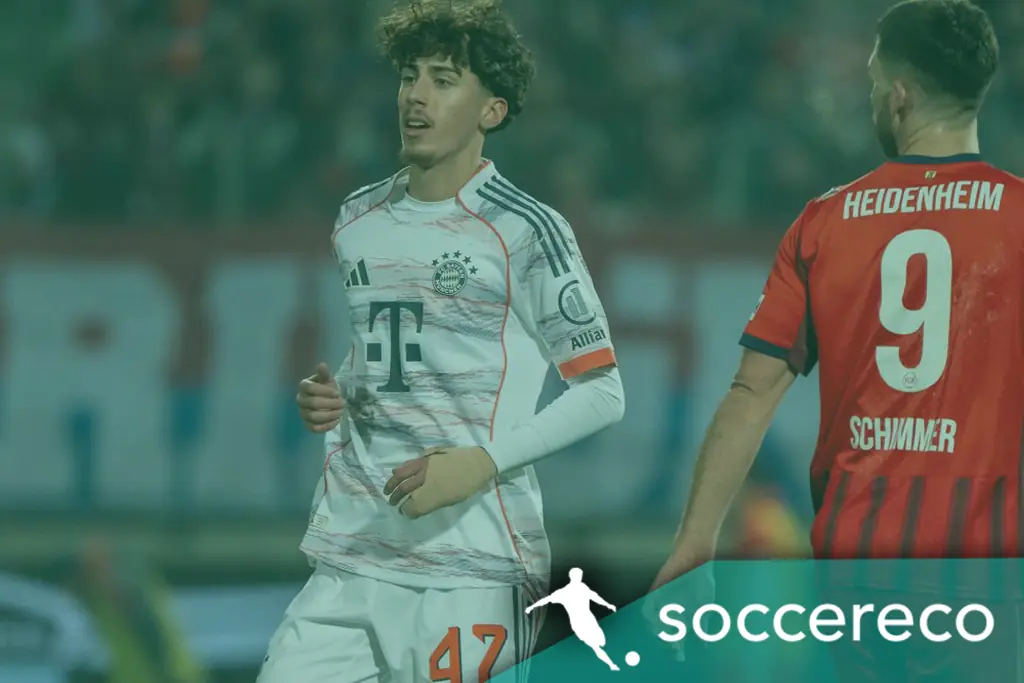
FC Bayern had to do without nine players in Heidenheim due to illness, injury, or suspension. The long list of absences handed Bundesliga debuts to two Campus talents: David Daiber and Cassiano Kiala.
Bayern’s trip to Heidenheim was meant to be a routine away assignment for a team chasing points at the top of the Bundesliga.
Instead, it became a night that underlined two of the club’s biggest strengths at once: the depth of the squad even in an emergency situation, and the constant readiness of the Campus pipeline to supply players who can step into elite-level football without the occasion swallowing them.
With nine first-team players unavailable due to a mix of illness, injuries and suspensions, Vincent Kompany arrived with a matchday group that was thinner than usual and required creative planning. The result was not a cautious or improvised performance, but a commanding four nil victory that simultaneously protected Bayern’s momentum and opened the door for two young players to take their first Bundesliga steps: midfielder David Daiber and centre back Cassiano Kiala. Both were rewarded for months of training alongside the first team and for showing, behind the scenes, that they could handle Bayern’s tempo, tactical demands and pressure.
Daiber’s debut was the more substantial of the two in terms of minutes and match context. He was introduced in the seventy second minute, replacing Raphael Guerreiro in central midfield at a point when the score was only two nil. While Bayern had control for long stretches, the game was not completely closed out and Heidenheim were still capable of creating moments, forcing Bayern to remain disciplined in their positioning and decision-making. This was not the kind of cameo where a young player enters a dead match just to tick a box. Daiber arrived with real responsibility, asked to keep Bayern’s rhythm, win second balls, circulate possession quickly and make the right choices under pressure.
Statistically, his first outing read like the ideal introduction for a midfielder in a dominant team structure. He completed every one of his fourteen passes, showing clean technique and an understanding of safe, efficient distribution. Just as importantly, his one attempted dribble and his one duel were both successful, which speaks to composure and timing rather than any attempt to impress with unnecessary risks. For a player making a debut, that balance matters. Coaches want young midfielders to show personality, but they value reliability even more, especially when the match is still alive. Daiber’s brief performance fit that profile perfectly, suggesting a player who understands that earning trust at Bayern starts with doing the basics at a high level.
Daiber’s story also carries a longer narrative of development inside the club. He joined Bayern in two thousand and sixteen from local Munich side TSV Milbertshofen and has been progressing through the system ever since. Turning nineteen in January, he is at an age where Bayern typically start testing whether a youth prospect can translate training performance into senior minutes. A debut in a competitive Bundesliga match is a significant checkpoint, and for someone who has been in the club environment for so long, it is also a signal that his work across multiple age groups has kept him on the radar through different coaching regimes.
If Daiber represented the steady, controlled debut in midfield, Kiala’s appearance added a historical edge that quickly drew attention. At sixteen years and three hundred and forty four days, the centre back became the second youngest player ever to appear for Bayern in the Bundesliga. Only Paul Wanner was younger when he featured on seven January two thousand and twenty two at sixteen years and fifteen days. Beyond the internal club record, Kiala’s age places him among the youngest Bundesliga players of all time, listed as the tenth youngest professional in league history. That kind of milestone inevitably increases scrutiny, because debuts at that age are rare, especially in a position as demanding as central defence where physical duels, reading of space, and decision speed are relentlessly tested.
Kiala’s minutes were limited to stoppage time, coming on for Dayot Upamecano, but the symbolism of the moment was major. Bayern Munich do not hand debuts to teenage centre backs lightly. Even short appearances are often carefully chosen to give a player a first taste of the league environment, the stadium atmosphere, and the speed of transitions. Kiala touched the ball three times and completed both of his passes, which is small in volume but still meaningful because it shows he entered the game and executed his instructions cleanly. In these late cameos, the challenge is often psychological. A young defender comes on knowing that one mistake is highly visible. Keeping it simple, taking correct positions, and playing the obvious pass can be the right debut.
Kiala’s pathway to Bayern has been faster than Daiber’s. He joined in the summer of two thousand and twenty four from Hertha BSC, arriving with a strong reputation and the label of a high ceiling talent. Bayern’s scouting and development model often targets elite youth profiles and then looks for the earliest safe moment to integrate them into first-team routines. For a teenage defender, training exposure and trust become the central currency. The club wants to see not just technical quality but also professionalism, learning speed, and emotional stability.
Kompany’s post match comments made it clear that the debuts were not an act of desperation but an extension of planning. He stressed that both players had been training with the senior squad for almost eight months and had accumulated significant experience inside those sessions. That detail is critical because it explains why Bayern could make these substitutions without fear. Players like Daiber and Kiala are not suddenly introduced on matchday and asked to improvise. They have spent months facing world class teammates every day, learning the team’s automatisms, pressing triggers, build up patterns and positional rotations. When Kompany points out that they train against Harry Kane and Joshua Kimmich, he is emphasizing the level of daily challenge that accelerates readiness. The line that matters most is the conclusion: they know the routines, and when they come on, the staff can trust them.
The wider context of the match made the message even stronger. Bayern were dealing with a situation that Kompany described in unusually vivid terms, comparing the week to a Covid era period when teams feared medical updates because bad news kept arriving. He likened it to an advent calendar delivering one negative message per day. Yet despite those absences, he highlighted that the team still looked like Bayern. In other words, the identity remained intact even when key pieces were missing. That is a hallmark of well drilled systems and of clubs that have depth not only in big name replacements but also in the academy and development layers.
For Bayern supporters, the Heidenheim win will be remembered as a dominant scoreline and a statement of resilience before the winter break. For the club’s internal development staff, it will also be logged as a successful integration moment. Daiber showed he can enter midfield and keep standards, while Kiala joined a very small list of teenagers trusted to appear in Bayern’s defence in the Bundesliga. Neither debut guarantees a long run of minutes, but both represent opportunities. Daiber now has tangible proof that he can handle top flight intensity, and Kiala has crossed the psychological threshold of making a Bundesliga appearance at an age where most players are still purely in youth football.
The next step for both players will likely be managed carefully. Bayern may continue to use them as training regulars with occasional match involvement, especially if injuries persist or squad rotation becomes necessary. Minutes in domestic cup matches, substitute appearances in comfortable league situations, and potential involvement in friendlies during breaks are common pathways. What the Heidenheim match proved is that, when the first team is stretched, Bayern’s Campus talents are not just emergency names on a team sheet. They are prepared options who can enter a live Bundesliga game, follow instructions, and contribute to a professional win.