FIFA wants to put an end to the frequent holding and blocking of opponents during set pieces. For that reason, VAR will be given more powers at the upcoming World Cup.
FIFA moves to tackle blocking and holding at set pieces ahead of World Cup
FIFA is preparing to take a much firmer stance on one of the most debated tactical trends in modern football: the blocking, holding and obstruction that increasingly takes place before corners and free kicks are even delivered into the penalty area. With set pieces now playing a bigger role than ever at the highest level of the game, football’s lawmakers have decided that referees and VAR officials need stronger tools to deal with situations that can directly influence major match-defining moments.
The issue has become especially visible in the Premier League, where clubs have invested heavily in set-piece coaching and where routines from corners and wide free kicks are now planned in extraordinary detail. What once looked like simple movement inside the box has increasingly become a sophisticated part of attacking strategy. Players block defenders, delay runs, create traffic around goalkeepers and try to free team-mates for a clear header or shot. In many cases, these actions are legal and part of the physical nature of football. But FIFA and refereeing authorities believe that the line has been crossed too often.
At the centre of the debate is the growing use of deliberate blocks before the ball is in play. An attacking player may stand in the path of a defender, hold him briefly, prevent him from tracking a runner or use his body to stop him from competing for the ball. These actions can be difficult for the referee to detect in real time, especially when several players are moving inside a crowded penalty area. Until now, VAR intervention in these situations has been limited, particularly when the offence happened before the corner or free kick had actually been taken.
Why set pieces have become such a major part of elite football
The change comes at a time when set pieces are no longer treated as secondary moments in a match. At elite level, they are now a central part of team identity, recruitment, analysis and match preparation. Clubs employ specialist coaches, study defensive weaknesses in detail and create routines designed to exploit even the smallest positional mistake. A corner is no longer just a ball into the box. It is often a rehearsed attacking pattern involving screens, delayed movements, decoy runs and carefully selected targets.
This evolution has made football more tactical, but it has also created new problems for referees. When a goal is scored from a set piece, the decisive action may not be the header or shot itself. It may be a block that happened two seconds earlier, before the delivery, which prevented a defender from reaching the danger zone. That is precisely the type of situation FIFA now wants VAR to be able to review.
Premier League matches have helped push the debate into the spotlight because the English game has seen a sharp rise in creative set-piece routines. Teams have become extremely clever at using physical contact without making it appear obvious. A small nudge, a body check or a player standing deliberately in the defender’s path can be enough to create separation. At the speed of live play, these moments can easily be missed. On replay, however, they can appear far more decisive.
Collina’s concern and the England example
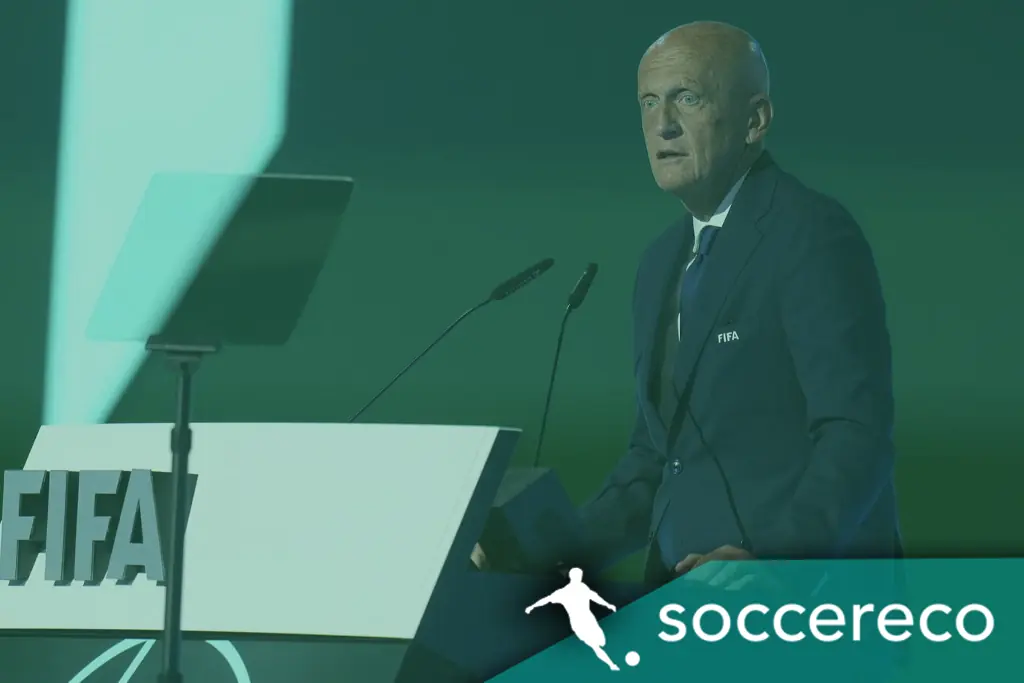
Pierluigi Collina, FIFA’s refereeing chief and one of the most respected figures in world refereeing, has been one of the strongest voices calling for change. The former Italian referee believes that football cannot ignore offences that clearly affect the outcome of an attacking set piece simply because they occur before the ball has been put into play.
Collina used England’s goal against Uruguay in a friendly earlier this year as an example of the type of incident he believes should be punishable. In that move, Ben White scored after Adam Wharton appeared to set a block that prevented José María Giménez from reaching the ball. In Collina’s view, the goal should not have stood because the block unfairly removed a defender from the play and gave the attacking team an advantage.
His argument is simple: if an attacking team commits an offence before the delivery and that offence helps create a goal or another decisive incident, the referee should have the possibility to correct it. For Collina, the fact that the ball has not yet been played should not protect the attacking team from punishment. If the illegal action has a direct impact on what happens next, it should be reviewable.
How VAR powers will change during the World Cup
Under the new approach approved by the International Football Association Board, VAR will be allowed to intervene during the World Cup when an attacking offence is detected before a corner or free kick is taken. This does not mean every small piece of contact will be reviewed. The intervention must still be linked to a major match-changing situation.
For example, if a team scores from a corner after one of its players clearly blocks or holds a defender before the ball is delivered, VAR may recommend an on-field review. The referee can then be sent to the monitor to examine the incident. If the referee agrees that an offence took place and that it affected the phase of play, the goal may be ruled out and the corner or free kick may have to be retaken.
The same principle may apply if the incident leads to the awarding of a penalty, a red card, a second yellow card or another decisive decision. In practical terms, VAR will not be checking every corner for minor grappling. The system is intended to deal with clear offences that have a direct consequence on the match.
This distinction will be crucial. FIFA knows that one of the biggest criticisms of VAR is that it can interrupt the rhythm of the game. Supporters, players and coaches have often complained about long delays and overly technical reviews. The objective is therefore to give officials more authority without turning every set piece into a lengthy forensic investigation.
A delicate balance between fairness and flow
The biggest challenge will be consistency. Set pieces are naturally physical. Defenders hold attackers, attackers block defenders, goalkeepers are crowded and players constantly fight for space. If officials apply the new interpretation too strictly, matches could become fragmented and frustrating. If they apply it too loosely, the change may have little practical effect.
That is why the phrase clear error remains central. VAR is not expected to intervene whenever there is contact. It should only step in when the attacking team has gained an obvious and unfair advantage from an offence that the referee missed. The difficulty will be deciding where that line sits in real match situations.
Coaches will also be watching closely. If early World Cup matches show that VAR is prepared to punish attacking blocks before corners, teams may quickly adjust their routines. Set-piece coaches will have to design movements that create space without crossing into obstruction. Players will need to be more careful with their arms, body position and timing. A routine that works in the Premier League or Champions League may suddenly become much riskier on the World Cup stage.
More responsibility for referees and VAR officials
The change also places greater pressure on VAR officials. They will need to identify whether an offence happened before the ball was played, whether it involved the attacking team and whether it had a genuine impact on the decisive action. That requires more than simply spotting contact. It requires understanding the movement, the purpose of the block and the consequence of the incident.
For referees on the pitch, the monitor review will become an important tool. The referee remains the final decision-maker, but the new powers mean that incidents previously outside the normal VAR intervention zone can now be brought to his attention. In high-pressure World Cup matches, these decisions could be hugely controversial.
There is also a communication challenge. Fans inside the stadium and viewers at home will need clear explanations. If a goal is ruled out because of a block that happened before the corner was taken, the decision may not be immediately obvious. Without proper communication, the change could add to confusion around VAR rather than reduce it.
Wrong corners, yellow cards and tactical injury breaks also targeted
The extension of VAR powers around attacking offences at set pieces is part of a broader attempt to improve decision-making and protect the integrity of the game. It had already become clear that VAR will also be allowed to intervene in cases involving wrongly awarded yellow cards, incorrectly awarded corners or goal kicks, and mistaken second yellow cards.
These areas have long caused frustration because they can have a major impact on matches while previously sitting outside the most familiar VAR categories. A wrongly awarded corner can lead directly to a goal. An incorrect second yellow card can change the entire balance of a game. FIFA’s position appears to be that if technology can correct a clear and important mistake, the laws should allow officials to use it.
Another issue FIFA wants to address is the growing use of feigned injuries to create tactical time-outs. In modern football, breaks in play can be used by coaches to reorganise a team, pass on instructions or slow the opponent’s momentum. While genuine injuries must always be treated seriously, FIFA is concerned that some players exploit the situation to create unofficial pauses in the match.
Taken together, these measures show a clear desire to close loopholes that teams have learned to exploit. Football has become increasingly analytical, and teams are always searching for marginal gains. FIFA and IFAB now appear determined to make sure those marginal gains do not come from actions that undermine fairness.
What this could mean for the World Cup
The World Cup will be the biggest test of the new approach. In a tournament where every goal can change a nation’s campaign, set-piece decisions will be examined in enormous detail. A disallowed goal from a corner could become one of the defining talking points of the competition. Equally, a goal allowed to stand despite a questionable block could lead to accusations of inconsistency.
For players, the message is clear: the penalty area before a corner or free kick is no longer a grey zone where almost anything goes. Holding, blocking and obstruction by the attacking side may now be punished if they influence a decisive moment. For coaches, it means set-piece routines must be cleaner, smarter and more carefully timed.
For referees, the challenge is to enforce the law without damaging the spectacle. Football needs fairness, but it also needs rhythm, emotion and spontaneity. VAR was introduced to correct clear mistakes, not to remove every physical duel from the game. The success of this change will depend on whether officials can use the new powers with restraint and consistency.
The growing importance of set pieces has changed football. Corners and free kicks are now tactical weapons, not simple restarts. FIFA’s decision is an acknowledgement of that reality. As attacking teams become more sophisticated, the laws and the use of technology are being adapted to keep up. The World Cup will show whether this new approach can make the game fairer without making it slower.