Jérémy Doku and Romelu Lukaku will play together for the Belgian national team at the 2026 World Cup, but the two already have a longer history. Eight years ago, Lukaku played an important role in Doku’s career path.
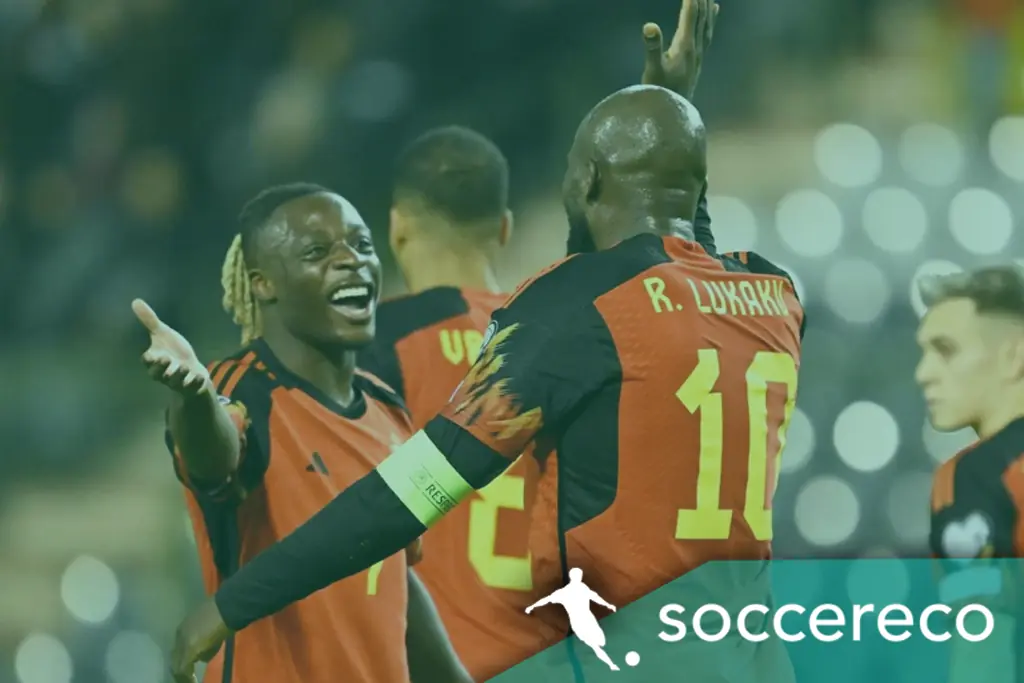
How Lukaku helped convince a sixteen-year-old Doku to stay in Belgium
Belgium will face Egypt on 15-06-2026 at 21:00, a match that will bring together several familiar names from the Belgian national team. Among them are Jérémy Doku and Romelu Lukaku, two players from different generations, but linked by a story that goes far beyond their time together with Belgium.
Today, Doku and Lukaku share the same dressing room at international level. They are both part of Belgium’s football identity, both products of a country that has become known for producing technically gifted, intelligent and explosive players. But long before they were teammates for their national side, Lukaku had already played a quiet but meaningful role in Doku’s career.
It is a story told by Jean Kindermans, the man who spent many years shaping the youth structure at Anderlecht. In a conversation with VI, Kindermans recalled a moment that, at the time, may have seemed simple and spontaneous, but later proved important in the development of one of Belgium’s most exciting attacking talents.
Sometimes, the direction of a football career is changed not by a contract, a transfer meeting or a formal presentation, but by a short conversation. In Doku’s case, it was a video message from Lukaku that helped him look at his future differently.
A young talent already attracting attention
Doku joined Anderlecht’s youth academy in 2012 and remained there until 2020. From an early age, he was not just another promising player in the system. He had something different. His speed, balance, courage in one-on-one situations and willingness to take risks made him stand out quickly.
Players like Doku are noticed early. A winger who can beat defenders naturally, who is not afraid to receive the ball under pressure and who brings unpredictability to the game is always going to attract interest. By the time Doku was approaching his sixteenth birthday, clubs from abroad were already watching closely.
That is often the most delicate moment in the development of a young player. At sixteen, the football world can suddenly become very loud. Agents, scouts, clubs and advisers all begin to appear. Promises are made. Bigger leagues are mentioned. Famous clubs enter the conversation. For a teenager and his family, it can be exciting, but also confusing.
Kindermans understood that danger well. Anderlecht had already seen many talented players move through its academy, and the club knew that development was not only about talent. Timing mattered. Environment mattered. The people around the player mattered. For Doku, the question was not whether he had the ability to play abroad one day. The question was whether that moment had already arrived.
Lukaku’s unexpected return to Anderlecht
The decisive moment came almost by accident. Lukaku was playing abroad at the time, representing Manchester United, but he had returned briefly to Anderlecht, his former club, to receive treatment for an injury. While there, he made time to speak with people he knew from his own years at the club.
According to Kindermans, Lukaku was always interested in the younger talents coming through Anderlecht. That detail says a lot about him. Even though he had already built a major career, played in England, carried Belgium’s attack and experienced football at the highest level, he still cared about the next generation.
During that visit, Kindermans and Lukaku started talking. The conversation naturally turned to the academy and to the most gifted young players in the system. Doku’s name came up quickly. Kindermans explained that the club was finding it difficult to convince the winger to stay, with interest arriving from several directions.
Lukaku’s response was immediate. He offered to call Doku directly. It was a natural reaction from someone who understood the pressure of being a young Anderlecht talent with major clubs watching. But Kindermans had another idea. Rather than a phone call, he suggested recording a video message. A video, he felt, might have a stronger and longer-lasting effect.
A message from experience, not from pressure
The idea was simple. Lukaku would speak directly to Doku, but without forcing him, without making him feel trapped, and without turning the situation into a dramatic appeal. It would simply be one Belgian talent speaking to another, one former Anderlecht youngster giving honest advice to a player who was standing at an important crossroads.
Kindermans filmed the message. Lukaku spoke for around a minute and a half. He addressed Doku personally, telling him that he had heard about his talent and understood that he had doubts about his future. That alone would have carried weight. For a sixteen-year-old, hearing those words from a player like Lukaku was not a small thing.
But the most powerful part of the message was not Lukaku’s status. It was his honesty. He did not simply tell Doku to stay because Anderlecht wanted him to stay. He spoke from his own life. Lukaku himself had left Belgium at a young age when he moved to Chelsea. He knew what it meant to enter a huge football environment early, with all the pressure, expectation and difficulty that comes with it.
He explained how difficult his first years in London had been. That perspective mattered. Young players often see only the attractive side of a big move: the stadiums, the shirt, the league, the money, the prestige. They do not always see the isolation, the competition, the adaptation, the emotional pressure and the danger of losing rhythm at a crucial age.
Lukaku had lived that reality. He was not speaking from theory. He was speaking from experience. That is why the message landed differently.
Why the timing was so important for Doku
For a player like Doku, staying at Anderlecht was not a step backwards. It was a chance to grow in an environment that knew him, trusted him and had a clear pathway for him. At that age, minutes, confidence and continuity can be more valuable than the name of the club on the contract.
Doku needed space to make mistakes. He needed coaches who understood his game and would allow him to keep attacking defenders. He needed to develop physically, tactically and mentally without being swallowed by the impatience that often surrounds elite football.
That is why Lukaku’s message was so relevant. He was not telling Doku to abandon ambition. Quite the opposite. He was reminding him that ambition also requires patience. A young player does not always need to move at the first opportunity. Sometimes, the smartest decision is to remain in the right place a little longer, become stronger, and leave only when the next step truly makes sense.
Kindermans was also careful with how he handled the situation. He did not send the video directly to Doku in a way that could make the youngster feel pressured. Instead, he sent it to Doku’s father. That detail is important. It shows that Anderlecht wanted to guide the family, not manipulate the player.
Kindermans later said he did not receive an immediate, specific response to the video. There was no dramatic reaction, no instant confirmation and no public statement. But later, he heard that Lukaku’s message had indeed played a role in Doku’s decision to stay at Anderlecht.
A small gesture with a lasting impact
Looking back, the story feels significant because of what Doku became. He continued his development at Anderlecht, gained experience, matured as a player and eventually made the move abroad when he was more prepared for it. His career path did not stop because he stayed in Belgium. In many ways, that extra period at Anderlecht helped give him the foundation to take the next steps with more confidence.
Football is full of stories about transfers, agents and negotiations. But this one is different. It is about influence without noise. Lukaku did not need to appear publicly, did not need to claim credit and did not need to make himself central to the story. He simply recorded a message because someone asked him to help a young player who was facing a difficult decision.
That kind of gesture often disappears from public view. Fans usually see the final version of a player: the international winger, the explosive dribbler, the star on the biggest stage. They rarely see the private moments that helped shape the journey. A conversation in a training ground. A message from an older player. A piece of advice given at the right time.
For Doku, hearing Lukaku speak about his own experience may have made the future feel clearer. It may have helped him understand that there is no shame in waiting, no lack of ambition in staying, and no guarantee that the biggest move at sixteen is always the best one.
Belgium’s generations connected by Anderlecht
The story also says something about Anderlecht’s role in Belgian football. The club has long been one of the key development centres in the country, producing players who have gone on to represent Belgium at the highest level. Lukaku and Doku are both part of that tradition, even if they came through at different times and followed different paths.
Lukaku was one of the great symbols of Anderlecht’s ability to produce elite attacking talent. Doku later became another example of the academy’s strength, particularly in developing players with technical courage and attacking personality.
Now, as Belgium prepare to face Egypt, the connection between the two players has another layer. They are not just teammates. One of them once helped the other at a decisive moment, long before they were sharing the same national-team environment.
That gives the story a human dimension. In football, careers are often described through statistics, transfer fees, goals and appearances. But behind every career, there are moments of uncertainty. Doku had one of those moments when he was still only sixteen. Lukaku, already experienced enough to understand the dangers of moving too quickly, offered him a message that came from the heart.
A reminder that development is about more than talent
Doku’s journey shows that talent alone is never the full story. The decisions made around a player can be just as important as the player’s natural ability. Choosing when to move, where to grow and who to listen to can shape everything that follows.
For young footballers, especially those with elite potential, the temptation to rush is always there. Big clubs can make the future look immediate. But development is rarely a straight line. Some players need time. Some need stability. Some need to become ready not just technically, but emotionally and mentally.
Lukaku knew that because he had experienced the other side. His message to Doku was powerful precisely because it did not come from a coach, director or agent. It came from a player who had been there before. He understood the dream, but also the cost of chasing it too early.
That is why this story remains so interesting. It is not only about Doku staying at Anderlecht. It is about how experienced players can influence the next generation in ways that are quiet but meaningful. It is about responsibility inside football. It is about one player using his own difficult lessons to help another avoid making a decision too quickly.
As Belgium and Egypt prepare to meet, Doku and Lukaku stand together as part of the same national team story. But years before that, their paths had already crossed in a way that helped shape Doku’s career. A chance visit, a conversation at Anderlecht, a short video message and a few honest words from Lukaku became part of the winger’s journey.
In the end, it is a reminder that careers are not built only on talent and opportunity. They are also shaped by timing, advice, trust and the people who care enough to say the right thing at the right moment.