The player for whom Real Madrid will break their own transfer record is likely to be João Neves or Vitinha. At least, that is what the Spanish sports newspapers are concluding after Florentino Pérez announced that Los Blancos will spend €150 million on one player this summer.
Real Madrid presidential battle heats up as Pérez prepares huge PSG transfer promise
The race for the presidency at Real Madrid has entered another dramatic stage, and once again the transfer market is being used as the main weapon to convince the socios. Florentino Pérez, who has built a large part of his modern legacy at the club around spectacular signings and global football stars, appears ready to respond to the challenge of Enrique Riquelme with a promise that fits perfectly into the old Galáctico tradition.
According to the Spanish sports press, the current Real Madrid president is prepared to make a major statement in the summer transfer window if he is re-elected. The figure being discussed is enormous: around €150 million for one single player. That kind of investment would not only underline the financial power of Real Madrid, but would also represent a symbolic move in a presidential campaign where promises, ambition and public perception matter almost as much as sporting planning.
A presidential race built around superstar promises
The battle between Pérez and Riquelme has quickly become more than a normal election campaign. It has turned into a contest of credibility, ambition and influence. Both candidates know that Real Madrid members expect a club that does not merely compete, but dominates. At the Santiago Bernabéu, success is measured in trophies, but also in the ability to attract the biggest names in world football.
Riquelme was the first to take the campaign into headline-grabbing territory by promising the arrival of Erling Haaland if he wins the presidential election. The Norwegian striker remains one of the most powerful names in the game, a player capable of changing the entire attacking structure of any team in Europe. By claiming that he could bring Haaland to Madrid, Riquelme attempted to present himself as a candidate with the connections and financial courage required to lead the club into a new era.
However, that promise immediately became controversial. Riquelme even suggested that an agreement already existed with the Manchester City striker, but that claim was quickly denied by Haaland’s agent, Rafaela Pimenta. The denial weakened the impact of the announcement and, according to reports, Manchester City could even consider legal action if they believe the comments crossed a line. In a campaign where image and authority are vital, that episode showed how dangerous transfer promises can become when they are not backed by clear and verifiable facts.
Pérez responds in classic Galáctico fashion
Florentino Pérez has rarely allowed himself to be outflanked when the conversation turns to elite signings. His presidency has always been associated with players who bring sporting quality, commercial impact and a sense of occasion. From his first Galáctico era to more recent major deals, Pérez understands better than most how a transfer can transform the mood around Real Madrid.
On Thursday, it was his turn to make a move. Pérez reportedly promised defensive reinforcements in the shape of Denzel Dumfries and Ibrahima Konaté if he remains in charge. Those two names already suggest a clear intention to strengthen the physical power, depth and reliability of the back line. Dumfries would bring energy, width and experience on the right side, while Konaté would add size, speed and authority in central defence.
But the real headline was not about the defence. The most important part of Pérez’s message was the promise of a true superstar, a player who could arrive for a fee of around €150 million and immediately become one of the faces of the project. According to Marca, the trail does not lead to the most obvious attacking names. Instead, everything appears to point towards Paris Saint-Germain.
Why PSG has become the centre of attention
The reason the Spanish press is looking towards Paris is simple. Pérez has reportedly ruled out several major names, including Jérémy Doku, Erling Haaland, Harry Kane and Michael Olise. Once those attacking options are removed from the list, the profile of the potential signing changes completely. Rather than a winger or striker, the focus appears to shift towards midfield.
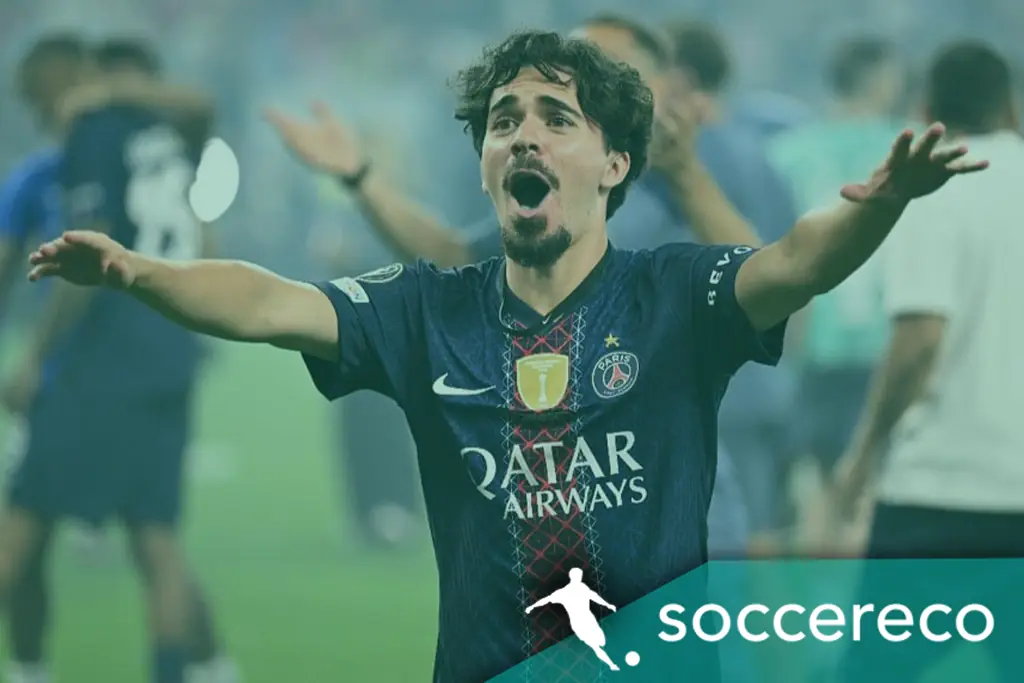
That is where Paris Saint-Germain becomes especially interesting. PSG have built one of the most balanced and technically gifted midfields in Europe, and two names stand out in particular: Vitinha and João Neves. Both Portuguese internationals have the kind of qualities that Real Madrid traditionally value in midfielders. They are comfortable under pressure, intelligent in possession and capable of controlling the rhythm of a match at the highest level.
Vitinha has been linked with Real Madrid for some time. His evolution in Paris has turned him into one of the most admired midfielders in Europe, not because he is the loudest or most spectacular player on the pitch, but because he often gives structure to everything around him. His ability to receive the ball in tight spaces, progress play and maintain control under pressure makes him exactly the kind of player who can influence elite Champions League matches.
João Neves, meanwhile, represents a slightly different profile. Younger, intense and tactically mature beyond his age, he is a midfielder with enormous long-term value. His energy, defensive instinct and ability to connect different phases of play have made him one of the most attractive young players in European football. The fact that José Mourinho is reportedly an admirer of Neves adds another layer to the story, especially with the Portuguese coach being mentioned as a possible future figure in the Real Madrid project.
Vitinha or João Neves: two very different statements
If Real Madrid were to move for Vitinha, the message would be immediate. It would be the signing of a player already operating at an elite level, someone who could step into a midfield full of stars and offer control, maturity and Champions League experience. Vitinha would not arrive as a promise for the future only. He would arrive as a player expected to influence the biggest nights straight away.
In tactical terms, Vitinha would fit well into a team that wants to dominate possession without losing verticality. He can play as an interior midfielder, help in the first phase of build-up and combine with technically gifted players around him. For a club like Real Madrid, where the midfield has to manage pressure, tempo and transitions, his profile is extremely attractive.
A move for João Neves would be slightly different. It would be a signing with both present and future value. Neves already has the quality to compete at the highest level, but his ceiling is what makes him so expensive and so desirable. Real Madrid have shown in recent years that they are willing to invest heavily in young midfielders before they reach their absolute peak. That strategy has worked well with players who arrived young and quickly became central to the team’s identity.
Neves would also offer intensity and balance. In a squad filled with attacking talent, midfielders who can recover the ball, cover space and maintain composure are essential. He is not only a ball-winner, and he is not only a passer. His value lies in the combination of both. That is precisely why PSG would be so reluctant to let him leave.
PSG will not be easy to convince
The biggest obstacle for Pérez is not necessarily the transfer fee itself. Real Madrid have the financial power and global status to make a huge offer. The real problem is PSG. Nasser Al-Khelaïfi has little reason to sell one of the key players from Luis Enrique’s successful team, especially at a time when PSG are trying to consolidate a new sporting identity built less around individual celebrity and more around collective strength.
Both Vitinha and João Neves are under contract for another three years, and neither has a release clause that would give Real Madrid a direct route to the signing. That detail is crucial. Without a fixed buyout clause, PSG control the negotiation completely. They can reject offers, raise the price or simply refuse to discuss a transfer at all.
For Real Madrid, that creates a difficult equation. A €150 million offer would be massive, but PSG may still consider the sporting cost too high. Replacing a midfielder of that level is not simple, particularly when the player already understands the coach’s system and has become part of a successful structure. In modern football, the most expensive players are not always the most available ones. Sometimes the most difficult deals are not about money, but about timing and strategic importance.
The election factor changes everything
What makes this story even more fascinating is the political context inside Real Madrid. Transfer rumours are always intense around the club, but during a presidential campaign they become part of something larger. A signing is no longer just a sporting decision. It becomes a message to the voters, a symbol of power and proof that a candidate can deliver what he promises.
Pérez knows this territory better than anyone. He has built campaigns and presidencies around the idea that Real Madrid must always be close to the best players in the world. For many socios, that ambition is part of the club’s DNA. They expect Real Madrid to be aggressive, persuasive and present whenever a major talent becomes available.
At the same time, modern football has changed. Clubs like PSG, Manchester City and others no longer need to sell their best players unless they choose to. Financial power is spread more widely across Europe than it was in the early Galáctico years. That makes the promise of a spectacular signing more complicated to fulfil. Real Madrid still have enormous appeal, but appeal alone is no longer enough to force every transfer.
A move that would reshape the Real Madrid midfield
If Pérez manages to bring either Vitinha or João Neves to Madrid, the impact would go far beyond the election campaign. It would reshape the midfield planning of the club for years. Real Madrid already have a strong base in that area, but elite clubs are constantly preparing for the next cycle. Midfield is the engine of the team, and the best squads are built by adding quality before the need becomes urgent.
Vitinha would give Real Madrid more control and technical security. João Neves would offer energy, aggression and long-term growth. Both would fit the profile of a club that wants to combine present success with future dominance. The difference lies in the message: Vitinha would feel like a signing for immediate command, while Neves would feel like a strategic investment in the next decade.
There is also the Portuguese connection to consider. With Mourinho reportedly admiring Neves and with both PSG midfielders coming from Portugal, the story has naturally gained extra attention. Portuguese football has produced a generation of technically excellent, tactically intelligent players, and Real Madrid have often been attentive to that market. Whether that interest becomes a serious negotiation remains to be seen.
A transfer promise full of risk and ambition
The coming weeks could reveal whether Pérez’s words are part of a genuine transfer plan or simply a campaign message designed to counter Riquelme’s Haaland promise. In either case, the effect is already clear. Real Madrid’s presidential race is now being fought not only through speeches and sporting projects, but through the names of players who could define the next era of the club.
For Riquelme, Haaland was the ultimate statement. For Pérez, the answer may come from Paris. Whether that means Vitinha, João Neves or another PSG star, the idea is clear: Real Madrid want to remind their socios that they remain capable of targeting players at the very top of the European game.
The difficulty is that PSG are not a selling club in the traditional sense, and Luis Enrique’s strongest players will not be allowed to leave without a fight. A €150 million offer would attract attention anywhere, but in Paris it may only be the starting point of a much more complicated conversation.
What is certain is that the story has all the ingredients of a classic Real Madrid transfer saga: politics, ambition, huge money, elite players and a president determined to show that the Galáctico spirit is still alive. If Pérez truly wants his next great signing to come from PSG, he will need more than a campaign promise. He will need a perfect negotiation, a willing player and a Paris Saint-Germain board prepared to open a door that, for now, appears firmly closed.